Spa Safety Barrier Inspection: Meeting Victorian Compliance Standards in 2026
- J B
- May 21
- 12 min read

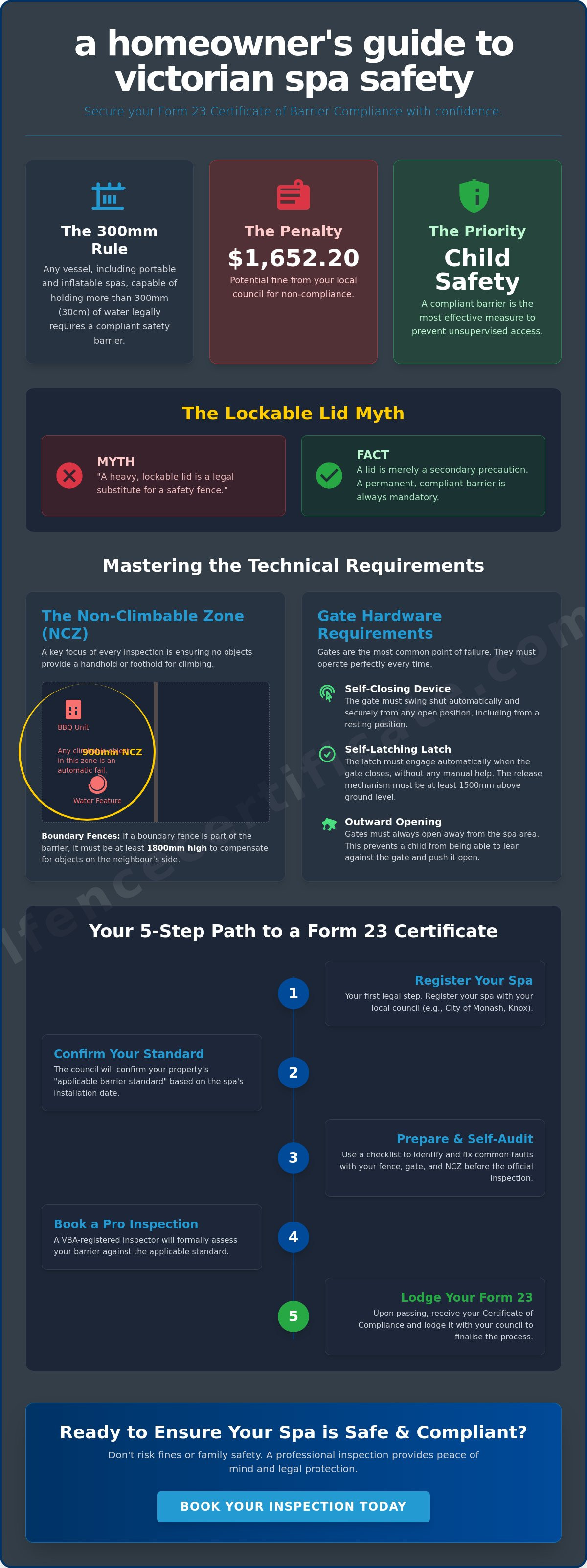
If you believe a lockable lid satisfies your legal obligations for spa safety in Victoria, you are risking more than just a $1,652.20 fine from your local council. The reality is that a lid is merely a secondary precaution and never a legal substitute for a permanent, compliant fence. With the introduction of the AS 1926.1:2024 standards on 1 May 2026, the criteria for a successful spa safety barrier inspection have become more stringent, focusing heavily on gate latches and non-climbable zones.
It is understandable to feel overwhelmed by technical jargon or anxious about failing an audit, especially when the stakes involve child safety and heavy penalties. You deserve to enjoy your spa without the lingering stress of non-compliance. This article will help you master the Victorian regulatory landscape so you can secure your Form 23 Certificate of Barrier Compliance with total confidence. We will break down the updated 2026 standards, clarify the physical requirements for your barrier, and provide a methodical roadmap to ensure your home remains both a safe environment and a legally protected asset.
Key Takeaways
Understand why any vessel capable of holding more than 300mm of water requires a formal spa safety barrier inspection to meet Victorian Building Authority mandates.
Identify the technical specifications for a compliant perimeter, including the 900mm Non-Climbable Zone and the requirement for outward-opening, self-latching gates.
Differentiate between secondary safety covers and the permanent physical structures legally required to prevent unsupervised access to your spa.
Utilise a proactive DIY preparation checklist to identify potential faults in your barrier hardware and surrounding landscaping before your official assessment.
Streamline the process of obtaining your Form 23 Certificate of Barrier Compliance to satisfy council requirements and ensure long-term family safety.
Table of Contents
What is a Spa Safety Barrier Inspection in Victoria?
A spa safety barrier inspection is a formal, legal audit designed to verify that your spa's fencing and gates effectively prevent unsupervised access by young children. In Victoria, this is not an optional safety check; it's a statutory requirement under the Building Regulations 2018. The process involves a Victorian Building Authority (VBA) registered inspector visiting your property to physically test every component of your barrier against the Australian Standard for Swimming Pool Fencing. The inspector focuses on structural integrity, gate functionality, and the presence of any climbable objects that could compromise the safety of the enclosure.
The ultimate objective of this assessment is the issuance of a Form 23 Certificate of Pool and Spa Barrier Compliance. This document serves as official proof that your barrier meets the specific safety standards applicable to your property. Failing to obtain and lodge this certificate with your local council can lead to significant legal liability. Beyond the risk of fines exceeding $1,600, a non-compliant barrier represents a serious physical threat to toddlers and young children in your household. A professional inspection replaces uncertainty with a methodical, fact-based verification of your home's safety.
The 300mm Rule: Does Your Spa Qualify?
Victorian law is very clear. If a vessel is capable of holding more than 300mm (30cm) of water, it must have a compliant safety barrier. This rule applies regardless of whether the spa is a permanent in-ground fixture or a portable, inflatable model bought from a local retailer. Many homeowners mistakenly believe that "temporary" or "relocatable" status exempts them from safety laws. It doesn't. If it can hold water deeper than a standard ruler, the legislation applies. The only legal exception is a personal hygiene bath used for washing and emptied immediately after use. If the vessel is used for wading, relaxing, or medicinal purposes, it's legally classified as a spa and requires a registered barrier.
Why Council Registration is Your Starting Point
You cannot proceed with a final spa safety barrier inspection until your spa is registered with your local council, such as the City of Monash or Knox. Registration is the essential first step because it determines your "applicable barrier standard." Safety regulations have evolved over several decades; the specific rules your barrier must follow depend entirely on when the spa was installed. Once you register the spa, the council will provide a formal letter confirming the date of construction and the specific version of the Australian Standard that applies to your property. You must provide these details to your inspector before they arrive. Without this council data, the inspector cannot accurately assess your barrier, making the registration process the foundation of your legal compliance.
Technical Requirements: Non-Climbable Zones and Gate Hardware
A successful spa safety barrier inspection relies on the precise physical geometry of your fencing and gates. Under the AS 1926.1 standard, every component is measured to ensure it denies a child any handhold or foothold. The physics of the barrier must work together to create a continuous shield. If a single element fails, such as a gate that doesn't latch from a resting position, the entire enclosure is deemed non-compliant. To ensure your barrier meets these complex physical requirements, you can book a professional assessment to identify faults before they become legal liabilities.
Landscaping and outdoor decor are the most common culprits for inspection failure. Items that seem harmless, like a heavy stone pot or a garden bench, can act as a step for a determined toddler. The inspector will look for any horizontal surfaces or objects that could facilitate climbing within the immediate vicinity of the fence. Maintaining a clear area is a mandatory, ongoing responsibility for every homeowner in Melbourne.
Mastering the Non-Climbable Zone (NCZ)
The NCZ is defined as a 900mm quadrant on the exterior of the barrier. This arc must be completely clear of climbable objects. Common obstructions that lead to failure include BBQ units, water features, or even low-hanging tree branches. If your barrier incorporates a boundary fence shared with a neighbour, the height requirement often increases to 1800mm. This ensures that even if the neighbouring side has climbable objects, the height remains an effective deterrent. These technical nuances are strictly enforced by the Victorian Building Authority to maintain a consistent safety standard across all residential properties.
Gate and Latch Compliance
Gate hardware is a critical pillar of any spa safety barrier inspection. Every gate must swing outward, away from the spa area. This design ensures that if a child pushes against the gate, they are pushing it into the latched position rather than opening it. The self-closing mechanism must be powerful enough to shut the gate from any open position, even when it's only slightly ajar. Additionally, the latching device must be positioned at a minimum height of 1500mm from the ground, or be shielded in a way that prevents a child from reaching through the bars to operate it. Regular wear and tear can cause gates to sag, so checking the alignment of your latch is a vital maintenance task.
The Lockable Lid Myth: Why a Cover is Not a Barrier
Many Melbourne residents are misled by marketing claims suggesting that a lockable, weight-bearing lid constitutes a legal safety measure. This is a dangerous myth. In Victoria, a lid is classified as a secondary safety item, never a primary barrier. During a spa safety barrier inspection, the presence of a lid is irrelevant to the core compliance assessment. The law requires a permanent physical structure, such as a fence, that remains in place regardless of whether the spa is in use or covered. Relying on a lid alone leaves your property non-compliant and your family at risk.
Relying on a lid creates a false sense of security. It only takes one instance of forgetting to lock the clips for the system to fail. A child can easily slide under a partially secured cover or climb on top of a deteriorated one. To satisfy the Victorian registration and inspection requirements, you must install a barrier that meets the height and non-climbability standards discussed earlier. Using a lid in tandem with a fence is excellent for heat retention and debris control, but only the fence provides the legal protection required for a Form 23 certificate.
The Legal Reality of Spa Covers in Victoria
When a manufacturer labels a spa cover as "Safety Rated," they are typically referring to the lid's ability to support the weight of an adult or prevent accidental falls. This rating does not equate to barrier compliance under AS 1926.1. Victorian inspectors are legally prohibited from issuing a certificate if the only protection is a lid. The Australian Standard distinguishes between a "cover" and a "barrier" based on the principle of passive protection; a fence is always "on," whereas a lid requires human intervention to be effective.
Portable Spas and Inflatable Tubs
Portable and inflatable units present unique challenges, especially in compact suburban backyards. Owners of "plug-and-play" models often neglect the spa safety barrier inspection process, assuming the temporary nature of the tub grants them an exemption. It doesn't. If you own an inflatable spa, you must organise a permanent barrier that encloses the unit. This may involve installing a dedicated glass or metal fence or ensuring the existing backyard perimeter meets the strict non-climbable zone requirements. Failure to treat these units with the same regulatory gravity as in-ground spas leads to immediate failure and potential council intervention.
Preparing for Your Melbourne Spa Inspection
Preparation is the most effective way to eliminate the anxiety of a spa safety barrier inspection. Most failures occur due to minor maintenance issues that are easily corrected before the inspector arrives. Begin with a rigorous 'Gate Swing Test'. Open your gate fully and release it; it must close and latch securely. Repeat this from a halfway position and then from just 10mm off the latch. If the gate fails to secure itself from any of these points, your barrier won't pass. Check the hinges for sagging or tension loss, as these are common mechanical failures in Melbourne's variable climate. You must also ensure the latching mechanism is free of debris and operates smoothly without manual assistance.
Beyond the gate, you must actively clear the Non-Climbable Zone (NCZ) of all potential hazards. Walk the perimeter of your barrier and remove any objects within 900mm of the fence. This includes pot plants, children's toys, garden hoses, or stacked timber. If you've recently added landscaping features or outdoor furniture, they may have inadvertently compromised your safety zone. Windows that form part of the barrier must also be addressed. Any window opening into the spa area must be restricted so that it can't open more than 100mm. This is typically achieved using sturdy, permanent window restrictors or security screens.
The 100mm Rule: Gaps and Openings
Ground clearance is a frequent point of failure. The gap between the bottom of your fence and the finished ground level must never exceed 100mm. If your garden has shifted or soil has eroded, you may need to adjust the barrier or add a solid plinth to close the void. Vertical bar spacing is equally critical. A simple DIY method involves using a standard tennis ball, which has a diameter of approximately 67mm. If you can easily push a tennis ball between your fence pickets, the gap's likely too wide. To secure windows that form part of the barrier, install permanent restrictors that prevent the sash from opening more than 100mm.
Signage and Documentation
Your CPR sign must be a durable, weather-resistant placard that's clearly visible from the spa area. Most Melbourne pool shops or hardware centres like Bunnings stock compliant signage. It should be mounted securely, typically at a height where it can be read easily during an emergency. Ensure the text hasn't faded due to UV exposure, as illegible signs are a common reason for failure. Before your spa safety barrier inspection, ensure you have your council registration letter ready. This document confirms the construction date and the version of the Australian Standard that applies to your property, allowing the inspector to verify compliance accurately.
To ensure your property meets every technical requirement, you should organise a spa barrier inspection with a qualified professional today.
Eastern Pool Barrier Compliance: Your Partner in Form 23 Certification
Eastern Pool Barrier Compliance operates as a dedicated authority for homeowners navigating the complexities of Victorian safety mandates. Engaging an independent specialist for your spa safety barrier inspection ensures an objective assessment of your property. Because we do not offer repair or installation services, we have no financial interest in identifying faults to generate extra work. This "No Repair" model guarantees that our findings are based solely on the physical requirements of the law, providing you with an honest path to compliance. Our priority is the accuracy of your safety assessment and the security of your household.
The process of securing a Form 23 Certificate of Pool and Spa Barrier Compliance should be methodical and transparent. We act as your vigilant protector, translating technical jargon into actionable information. By focusing exclusively on inspections, we provide a streamlined service that moves quickly from the initial physical assessment to the finality of a completed task. This efficiency is vital for Melbourne residents facing strict council deadlines and the threat of substantial non-compliance fines.
Serving the Eastern Suburbs
Our expertise is concentrated within Melbourne's eastern corridor. We possess a deep understanding of the specific regulatory nuances enforced by councils such as Whitehorse, Maroondah, and the Yarra Ranges. Homeowners in established areas like Box Hill or Lysterfield often face unique landscape challenges, such as sloping blocks or heritage-listed boundary fences, which can complicate the certification process. We provide efficient turnaround times for residents in Glen Waverley, Ringwood, and Croydon, ensuring your safety obligations are met without unnecessary delays. Whether you are in Rowville, Mulgrave, or Vermont, we understand the local terrain and the specific expectations of your municipality.
Booking Your Stress-Free Inspection
On the day of your spa safety barrier inspection, you can expect a professional, thorough, and polite evaluation of your barrier. Our inspector will systematically test every gate, fence panel, and non-climbable zone to ensure they meet the criteria discussed earlier in this guide. If your barrier meets the mandatory standard, we issue your Form 23 certificate promptly. If rectifications are required, we provide a clear, technical report that explains exactly what needs to be addressed. We then guide you through the final steps of navigating local council portals to lodge your documentation. Secure your property and protect your family by choosing a partner who prioritises precision and safety above all else.
Book your Melbourne spa inspection today and ensure your home meets the 2026 Victorian compliance standards.
Secure Your Form 23 Compliance Today
Navigating the 2026 Victorian safety standards requires technical precision and a clear understanding of your legal responsibilities. You now know that a lockable lid is never a substitute for a permanent fence and that the 900mm Non-Climbable Zone is a non-negotiable requirement for every property. Proactive preparation, including the gate swing test and clearing debris from your barrier perimeter, is the most effective way to avoid council fines and ensure the safety of your household.
Eastern Pool Barrier Compliance is here to take the burden of regulation off your shoulders. As a VBA Registered Building Inspector specialising in Melbourne's Eastern Suburbs, we provide a thorough and independent spa safety barrier inspection. Because we offer an independent service with no conflict of interest, you can trust that our assessment is focused entirely on your safety and legal standing. Don't leave your family's protection or your property's compliance to chance. You can easily Secure Your Spa Compliance Certificate with Eastern Pool Barrier Compliance and enjoy your spa with complete peace of mind.
Frequently Asked Questions
Do I need a fence for a spa with a lockable lid in Victoria?
Yes, a permanent safety barrier is mandatory regardless of whether your spa has a lockable lid. Victorian legislation does not recognise a lid as a primary safety measure. Any vessel capable of holding more than 300mm of water must be enclosed by a compliant fence that meets the Australian Standard for safety.
How much does a spa safety barrier inspection cost in Melbourne?
The cost of a spa safety barrier inspection varies depending on whether you engage a private building inspector or use a service provided by your local council. Fees are typically structured to include the initial assessment and the issuance of the compliance certificate. You should request a specific quote to understand the current rates applicable to your suburb and property type.
What happens if my spa barrier fails the initial inspection?
If your barrier is deemed non-compliant, the inspector will issue a notice detailing the required rectifications. You are generally provided with a period of 60 days to fix the identified faults. Once the repairs are complete, a follow-up assessment must be conducted to verify that the barrier now meets the necessary legal standards.
How often do I need to have my spa barrier inspected in Victoria?
You must have your spa barrier inspected and a new Certificate of Barrier Compliance lodged with your local council every four years. This cycle ensures that wear and tear, such as gate sag or latch failure, is identified and corrected. Your council will typically send a reminder notice before your next lodgement deadline expires.
Does an inflatable or portable spa need a safety fence?
Yes, any inflatable or portable spa that can hold more than 30cm of water requires a compliant safety barrier. The temporary or relocatable nature of these units does not exempt them from the Building Regulations 2018. You must ensure a permanent, registered barrier is in place before the spa is filled with water.
What is a Form 23 and why do I need it for my council?
A Form 23 is the official Certificate of Barrier Compliance issued by a registered building inspector. You need this document to prove to your local council that your spa safety barrier inspection was successful. Lodging this certificate is a legal requirement that protects you from significant fines and confirms your barrier meets safety mandates.
Can I use my house wall as part of the spa barrier?
A house wall can function as part of the barrier, provided it does not contain any doors that open directly into the spa area. Any windows in that section of the wall must be restricted so they cannot open more than 100mm. These restrictions must be permanent and robust enough to prevent a child from bypassing the safety zone.
What are the fines for a non-compliant spa fence in Melbourne?
Failure to lodge a certificate of barrier compliance by the required date can result in a fine of up to $1,652.20. Additionally, councils can issue on-the-spot fines of approximately $330 for failing to comply with a barrier improvement notice. Maintaining a compliant barrier is essential to avoid these penalties and ensure the safety of your household.


Comments