Professional Pool Fence Inspection Service in Melbourne: Ensuring Your Compliance
- J B
- May 27
- 13 min read

The most convenient path to pool safety compliance is often the most compromised if your inspector also profits from the repairs they recommend. You shouldn't have to wonder if a failed report is a genuine safety concern or a sales tactic for unnecessary fence work. Many Melbourne homeowners find themselves overwhelmed by the Victorian Building Authority (VBA) regulations and the fear of heavy council fines, especially with the introduction of the new AS 1926.1:2024 standards on 1 May 2026. Understanding exactly what happens during a pool fence inspection is the first step toward regaining control over your home's safety and legal standing.
We agree that the process of registering your pool and ensuring it meets strict Australian Standards can feel like a bureaucratic minefield. That's why we offer a strictly independent assessment designed to help you secure your Form 23 Certificate of Pool and Spa Barrier Compliance with total transparency. Our goal is to protect your family and your finances by providing an expert, unbiased evaluation of your pool barrier without any conflict of interest.
This article explains the physical assessment process and the specific benchmarks our inspectors use to evaluate your gates, latches, and non-climbable zones. You'll learn how to prepare for your visit and how to receive clear, actionable feedback that ensures your pool remains a safe sanctuary rather than a legal liability.
Key Takeaways
Understand your legal obligations under the VBA to register your pool and adhere to the mandatory four-year inspection cycle to avoid council penalties.
Discover exactly what happens during a pool fence inspection, including rigorous physical testing of gate latches and a thorough perimeter assessment against Australian Standards.
Learn why choosing an independent inspector eliminates the conflict of interest found with firms that profit from the repairs they recommend.
Access a practical preparation checklist to organise your barrier, clear non-climbable zones, and increase your chances of a first-time pass.
Find out how to streamline the process of obtaining your Form 23 Certificate of Pool and Spa Barrier Compliance for properties in Melbourne's eastern suburbs.
Table of Contents
Why a Professional Pool Fence Inspection Service is Mandatory in Victoria
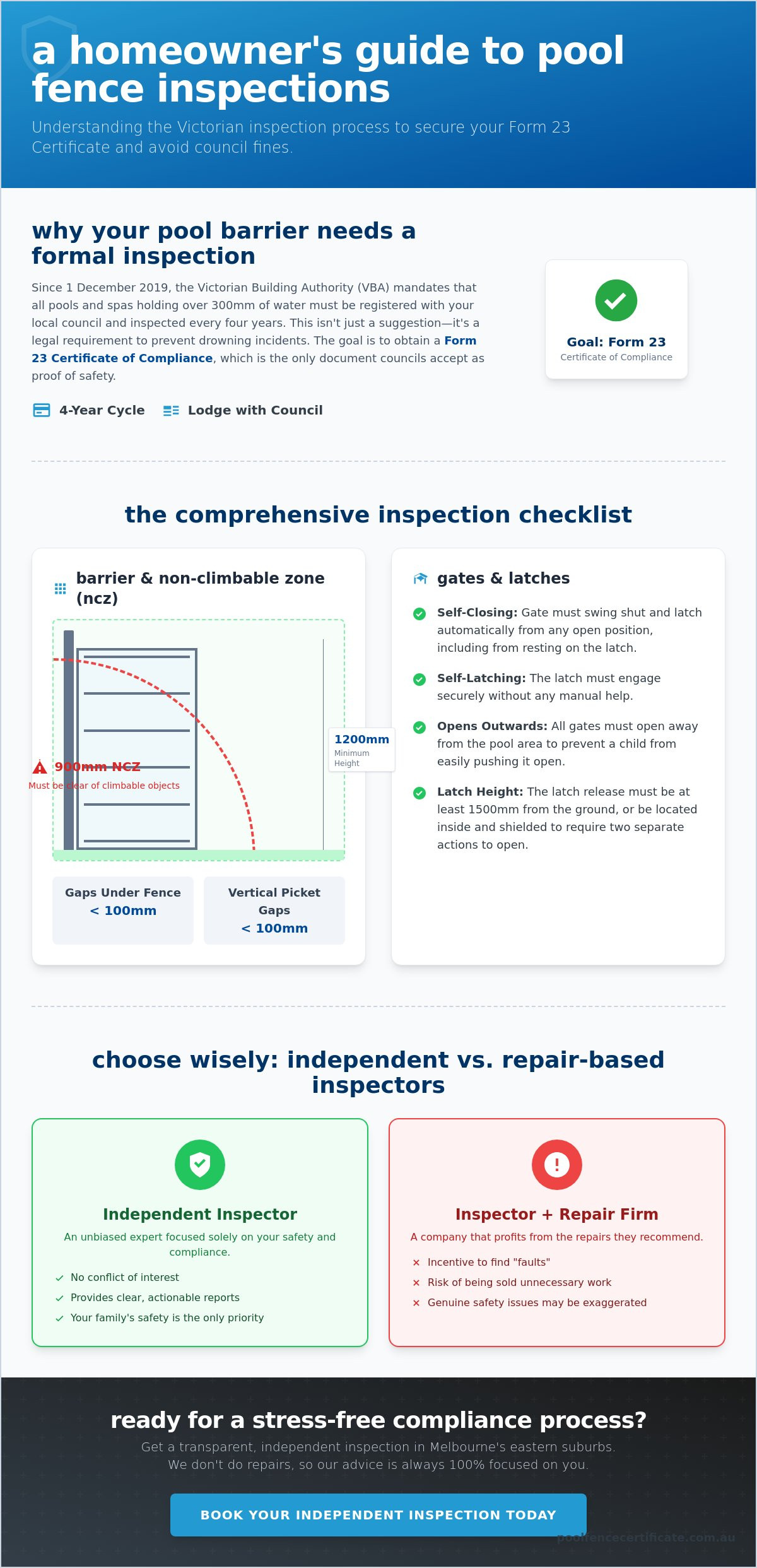
Owning a pool in Melbourne carries a significant weight of responsibility that extends beyond routine maintenance. Since 1 December 2019, the Victorian Building Authority (VBA) has mandated that every private pool and spa capable of holding more than 300mm of water must be registered with the local council. This registration is the first step in a strictly regulated safety program designed to reduce drowning incidents across the state. Maintaining pool fence safety standards is not merely a recommendation; it's a statutory requirement that ensures every barrier remains functional and effective over time.
Local councils across Melbourne, from the City of Monash to Maroondah and Whitehorse, are the primary enforcers of these regulations. They maintain the register and track the compliance status of every property. If you fail to lodge your compliance certificate by the designated deadline, you face substantial financial penalties and potential legal liability. It's vital to distinguish between a casual "compliance check" and a formal Victorian mandatory inspection. A casual check might identify obvious flaws, but only a formal assessment by a registered building inspector satisfies the law. Understanding what happens during a pool fence inspection is essential because the process is a rigorous, fact-based evaluation of your barrier's physical integrity and its alignment with current mandates like AS 1926.1:2024.
The 4-Year Inspection Cycle
Victoria's compliance framework operates on a recurring four-year cycle. Your specific deadline is determined by the date your pool or spa was constructed. For example, older pools built before 1991 had different initial deadlines compared to those installed after 2010. You shouldn't wait for a council notice to arrive before you organise your assessment. Proactive safety assessments are particularly important for families in Melbourne's Eastern suburbs, where mature gardens and shifting soil can compromise fence stability or gate alignment. Waiting until the last minute often leads to unnecessary stress and a rush to find an available inspector before the council's cut-off date.
Form 23: Your Goal for Legal Compliance
The ultimate objective of any professional inspection is the issuance of a Form 23 Certificate of Pool and Spa Barrier Compliance. This document is the only evidence the council accepts as proof that your barrier meets the applicable Australian Standards. Only a registered building surveyor or a registered building inspector can issue this specific Victorian certificate. Once issued, you have a strict 30-day window to lodge this certificate with your local council. Knowing what happens during a pool fence inspection helps you prepare your property so that the inspector can verify every gate, latch, and fence panel without delay. This preparation moves you closer to that vital Form 23 and the peace of mind it provides for your household.
What Happens During a Comprehensive Pool Barrier Inspection?
A professional inspection is a methodical diagnostic process that prioritises physical verification over simple visual checks. It begins with a total perimeter walk-through to ensure the barrier is continuous and free from breaches. When considering what happens during a pool fence inspection, you should expect a physical stress test of every panel. The inspector will check for stability and ensure that materials like glass or aluminium haven't degraded or become loose over time. This stage is critical for maintaining adherence to Victorian pool safety regulations, which demand that barriers remain robust under pressure and cannot be easily pushed over or pulled apart.
Precision is the hallmark of a compliant barrier. Every fence section must maintain a minimum height of 1200mm from the finished ground level. We also measure vertical gaps between pickets to ensure they don't exceed 100mm, preventing a child from squeezing through. A major focus is the Non-Climbable Zone (NCZ). This is a 900mm quadrant on the outside of the fence that must be clear of any "climbable objects" such as taps, pot plants, or sturdy branches. Even a small ledge can provide enough purchase for a child to scale the barrier. If you're unsure if your backyard layout meets these strict criteria, it's worth reviewing a professional compliance guide before your appointment.
Technical Standards and Measurements
We use calibrated equipment to verify that ground clearances do not exceed 100mm at any point. This prevents children from crawling under the fence. The inspector also checks the "NCZ 5" zone, which is the internal 300mm area of the fence. This area must remain clear of objects that could facilitate climbing from the inside. We assess the rigidity of the entire structure to ensure that no part of the barrier can be flexed to create a gap larger than the legal limit.
Gate and Latch Functionality
Statistics from the VBA indicate that gate failure is the most frequent reason for non-compliance in Melbourne. During the assessment, we test the gate's self-closing and self-latching mechanisms from various positions, including just a few centimetres off the latch. The gate must swing shut and secure itself without manual assistance every single time. We also verify that the gate opens outward, away from the pool, and that the latch is positioned at least 1500mm above the ground. If the latch is lower, it must be shielded so it's unreachable through the fence. This rigorous testing is a core part of what happens during a pool fence inspection, ensuring the most frequently used part of your barrier remains its most secure.
Independent Inspectors vs. Repair Firms: Making the Right Choice
Choosing the right practitioner for your safety assessment is just as critical as the physical barrier itself. Many Melbourne residents are unaware that a significant conflict of interest exists within the pool safety industry. Some firms offer discounted assessments as a "loss leader," only to recoup those costs by identifying "faults" that require their own expensive repair services. By choosing a strictly independent service like Eastern Pool Barrier Compliance, you ensure the person evaluating your safety is not motivated by construction profits. This level of transparency is vital when you consider what happens during a pool fence inspection; the focus remains entirely on regulatory accuracy rather than sales targets.
Unbiased reporting is the most effective way for homeowners to save money on their compliance journey. When an inspector has no financial stake in the "rectification" phase, they're more likely to provide practical, cost-effective advice. For example, a non-independent firm might suggest a full gate replacement for a minor latching issue that actually only requires a simple hinge adjustment. An independent inspector provides a clear, objective list of required fixes. This empowers you to organise your own repairs or even perform minor adjustments yourself, protecting your household budget from over-engineered solutions.
The Problem with "Inspection and Repair" Packages
When an inspector also operates a repair business, there's an inherent incentive to over-complicate minor issues to secure lucrative construction work. We believe the assessment and the fix should remain separate to maintain professional integrity. Receiving a clear list of required rectifications allows you to shop around for the best price or handle simple tasks, such as moving a pot plant or trimming a branch, without being charged a premium service fee. This separation of powers ensures that your safety report is a factual document, not a sales pitch.
Professional Integrity and VBA Registration
Professional integrity is non-negotiable in the Victorian regulatory environment. It's essential to verify that your inspector is properly registered with the Victorian Building Authority (VBA). This registration confirms the practitioner has met the rigorous training requirements and holds the necessary professional indemnity insurance to protect your interests. For families in Melbourne's East, local expertise is a significant advantage. An inspector who understands the specific building styles and council requirements in areas like Wheelers Hill or Ringwood can provide more precise guidance. They understand exactly what happens during a pool fence inspection in these local jurisdictions and can help you navigate the lodgement process with confidence and efficiency.
Preparation Checklist: Organise Your Barrier for a First-Time Pass
Achieving a first-time pass requires a proactive approach to your property's layout. Many homeowners feel anxious about what happens during a pool fence inspection, but much of the assessment focuses on easily rectifiable issues. By conducting your own preliminary walk-through, you can identify and resolve common failure points before the official visit. We recommend using a comprehensive Melbourne pool safety inspections guide to ensure no detail is overlooked. This preparation reduces the likelihood of needing a follow-up visit and speeds up the path to your Form 23 Certificate.
The DIY Pre-Inspection Walkthrough
The gate is your primary line of defence. It must swing shut and latch securely from any open position; this includes when it's resting just a few millimetres from the latch. Before your inspector arrives, perform these basic checks to ensure your barrier is ready for assessment:
Test the gate: Ensure it swings shut and latches from any open position automatically without manual assistance.
Inspect the perimeter: Look for loose palings, rusted sections, or gaps under the fence that exceed 100mm.
Clear the zone: Remove any climbable objects, such as chairs, ladders, or large pot plants, within 900mm of the outside of the fence.
Check the perimeter for ground erosion that has created gaps larger than 100mm. These openings are large enough for a small child to pass through, representing a critical safety breach. Items like ladders or even decorative garden features can provide a foothold for an adventurous child and must be moved well away from the barrier before the professional evaluation begins.
Managing Vegetation and Landscaping
Melbourne's lush gardens often present the biggest challenge to compliance. Overhanging branches or sturdy shrubs within the NCZ are major causes of inspection failure. If a branch is strong enough to support a child's weight, it must be trimmed back. Maintaining a clear, sterile zone around your barrier is the most effective way to ensure a successful assessment. Secure any loose elements and ensure that landscaping hasn't encroached on the required 1200mm fence height. Understanding what happens during a pool fence inspection helps you see your garden through the eyes of an inspector, identifying "climbable" paths you might otherwise ignore.
Trim trees or shrubs that have grown into the 900mm non-climbable zone.
Secure loose trellis or decorative lattice features near the barrier perimeter.
Prune leaning branches, which are a common cause of failure in established Melbourne gardens.
Ensure the inspector has clear access to the entire barrier on the day of the appointment. Unlock any side gates and move obstacles that might block the physical assessment of the fence line. While not always required, having access to a power point can be helpful for specific testing equipment. Taking these steps demonstrates your commitment to safety and allows the process to move efficiently. If you're ready to secure your property, you can book your independent inspection today and move one step closer to your legal compliance.
Booking Your Inspection in Melbourne’s Eastern Suburbs
Securing your property's legal standing shouldn't be a source of constant stress for your family. Our service is designed to be a streamlined, professional solution for homeowners who value accuracy and independence. While we've detailed exactly what happens during a pool fence inspection, the final administrative phase is where our local expertise becomes most valuable. We provide a clear, methodical path from your initial booking to the final lodgement of your Form 23 Certificate, ensuring you meet every regulatory benchmark set by your local council.
We've built our reputation on reliability and a deep understanding of the Victorian regulatory landscape. For busy Melbourne families and property managers, time is a finite resource. We respect this by offering a punctual, efficient service that prioritises your compliance without unnecessary delays. Beyond simply knowing what happens during a pool fence inspection, you need the assurance that your inspector is a registered practitioner who understands the high stakes of child safety and legal liability. We act as your knowledgeable guide, removing the burden of complex VBA requirements from your shoulders.
Local Service Areas in Melbourne East
Our team possesses specific expertise in the unique requirements of Monash, Knox, and Maroondah councils. We understand how local building styles in areas like Wheelers Hill and Glen Waverley can impact barrier compliance, particularly regarding older fences or established landscaping. Residents in Vermont, Rowville, and Mulgrave benefit from our focused local presence, which allows for faster turnaround times and a more personalised service. Whether you own a standard suburban block in Ringwood or a larger acreage in Lysterfield, we provide tailored advice that respects the specific geometry of your property and the safety of your household.
Next Steps to Compliance
Once your physical assessment is complete and your barrier is deemed compliant, we issue your Form 23 Certificate of Pool and Spa Barrier Compliance. It's vital to remember that this certificate is valid for only 30 days; you must lodge it with your local council within this timeframe to satisfy your legal obligations. If your barrier requires adjustments to meet the current standards, don't panic. Under Victorian law, you have a 60-day window to rectify any non-compliance issues. We support you during this period by providing clear, actionable feedback on exactly what needs to be fixed, allowing you to organise repairs with total transparency. To secure your property and protect your family, book your professional pool fence inspection service today and let us handle the complexities of Victorian compliance for you.
Secure Your Compliance and Protect Your Family Today
Maintaining a compliant pool barrier is a vital legal and moral obligation for every Victorian homeowner. You now have a clear understanding of what happens during a pool fence inspection and how to prepare your property for a successful assessment. By prioritising an independent service, you eliminate the risk of repair-driven conflicts and ensure your safety report is based strictly on regulatory standards. This objective approach is the most efficient way to protect your household budget while meeting the high benchmarks set by the VBA.
As a VBA Registered Building Inspector specialising in Melbourne's Eastern Suburbs, we provide the authoritative guidance you need to navigate these complex requirements. Our local expertise ensures your assessment is handled with precision and professional integrity. Don't leave your family's safety or your legal standing to chance. Secure Your Form 23 Certificate; Book an Inspection with Eastern Pool Barrier Compliance today. We look forward to helping you achieve total peace of mind with a transparent, independent, and unbiased assessment of your pool or spa barrier.
Frequently Asked Questions
How much does a pool fence inspection service cost in Melbourne?
Costs for a professional assessment vary depending on the practitioner and the complexity of your specific pool or spa barrier. The Victorian Building Authority (VBA) does not mandate a set fee, so we recommend obtaining a quote from a registered inspector to understand the investment required for your property. An independent service provides value by ensuring your report is based solely on safety standards rather than a desire to sell additional repair work.
How long is a Form 23 Certificate of Pool Barrier Compliance valid for?
A Form 23 Certificate is valid for exactly 30 days from the date of issue. You must lodge this document with your local council within this 30-day window to satisfy your legal obligations. Once successfully lodged and processed by the council, your barrier's compliance is generally registered for a four-year period, after which a new inspection and certificate will be required to maintain your standing.
Can I perform my own pool safety inspection for council registration?
No, you cannot conduct your own formal inspection for the purpose of Victorian council registration. While a DIY walkthrough is an excellent way to prepare, only a registered building surveyor or a registered building inspector can legally issue a Form 23 Certificate. These practitioners have the technical training and VBA registration necessary to verify that your barrier meets the specific Australian Standards applicable to your pool's construction date.
What happens if my pool fence fails the initial inspection?
If your barrier is deemed non-compliant, the inspector will issue a detailed report identifying the specific faults that must be addressed. Under Victorian law, you have a maximum of 60 days to rectify these issues and organise a re-inspection. Understanding exactly what happens during a pool fence inspection allows you to prepare effectively, potentially avoiding the need for this secondary visit and the associated administrative delays.
Do I need an inspection if I have an above-ground pool or outdoor spa?
Yes, any structure capable of holding more than 300mm of water must have a compliant safety barrier and be registered with the council. This requirement applies to permanent above-ground pools, inflatable pools, and all outdoor spas. These installations are subject to the same four-year mandatory inspection cycle as traditional in-ground pools to ensure the safety of children and the broader community.
How soon can I get an inspector to visit my property in the Eastern Suburbs?
Availability for inspections in Melbourne’s East depends on the current demand and the volume of council deadlines in your specific municipality. We suggest booking your assessment as soon as you receive your council registration notice to ensure you have ample time for the process. Early booking is the most effective way to manage your 60-day rectification window if your barrier requires minor adjustments for compliance.
What is a Non-Climbable Zone (NCZ) and why is it important?
The Non-Climbable Zone is a 900mm quadrant on the outside of the fence that must be completely clear of any objects that could facilitate climbing. This zone is a primary focus of what happens during a pool fence inspection because it prevents children from using garden furniture, taps, or branches as footholds. Maintaining a clear NCZ is one of the most critical factors in achieving a passing result under the AS 1926.1 standards.
Does the inspector provide the repairs if my fence is non-compliant?
We do not offer repair or installation services; we are a dedicated, independent inspection firm. This separation of services is a deliberate choice to ensure our assessments remain completely unbiased and free from any conflict of interest. By focusing exclusively on certification, we provide homeowners with a transparent evaluation and actionable feedback without the pressure of an upsell for construction work.


Comments