Professional Pool Fence Inspection Melbourne: The Complete 2026 Compliance Guide
- J B
- May 19
- 13 min read

The safest pool barrier in Victoria isn't necessarily the newest one; it's the one assessed by an expert who has no financial interest in your repairs. With the AS 1926.1:2024 standard coming into effect on 1 May 2026, arranging a pool fence inspection melbourne has become a critical step in avoiding heavy council fines and ensuring genuine household safety. It's common to feel concerned about "dodgy" inspectors who might fail a gate just to sell a fix, but true compliance relies on transparent, independent feedback that puts your family first.
We understand that the shift to the National Construction Code 2025 and the complexities of four-yearly registration can be daunting. This guide promises to demystify the Victorian safety laws and provide a stress-free path to securing your Form 23 Certificate of Pool and Spa Barrier Compliance. We will walk you through the updated non-climbable zone requirements, gate latching standards, and the essential 30 day lodgement process to ensure your pool remains a place of joy rather than a legal liability.
Key Takeaways
Navigate the 2026 Victorian safety registration scheme and understand the regulatory role of the Victorian Building Authority in overseeing compliance standards.
Identify the specific Australian Standard applicable to your pool's construction date to ensure your pool fence inspection melbourne is assessed against the correct legal criteria.
Recognise the safety advantages of the independent auditor model, which eliminates the conflict of interest inherent in businesses that offer both inspections and repairs.
Utilise a high-stakes pre-inspection checklist to address overlooked barrier faults and increase your chances of securing a successful assessment on the first attempt.
Master the final administrative requirements for obtaining your digital Form 23 and lodging it with your local council within the mandatory 30-day window.
Table of Contents
Professional Pool Fence Inspections: Navigating Melbourne’s Safety Laws in 2026
Victoria's pool safety registration scheme has entered a new phase of stringent enforcement in 2026. If you own a pool or spa in Melbourne, compliance is no longer a discretionary task; it's a rigid legal mandate. The Victorian Building Authority (VBA) now oversees a highly regulated network of inspectors, ensuring that every professional conducting a pool fence inspection melbourne adheres to the latest pool fence safety standards. This oversight is designed to eliminate ambiguity in safety assessments. Failing to register your barrier with your local council or missing a mandatory inspection deadline can lead to on-the-spot fines exceeding A$300, while maximum court-imposed penalties for persistent non-compliance can reach thousands of dollars.
The Legal Weight of the Form 23 Certificate
A Form 23 Certificate of Pool and Spa Barrier Compliance is the only document that legally validates your barrier's safety under the Building Regulations 2018. It signifies that a registered inspector has physically assessed your fence and confirmed it meets the specific Australian Standard applicable to your pool's date of construction. This certificate isn't a one-time requirement. Victorian law mandates a renewal cycle every four years to account for wear, tear, and shifting ground. Don't be misled by a casual "safety check" offered by a pool cleaner or a fencer. These informal assessments carry no legal standing. Only a VBA-licenced inspector can issue the Form 23 required to keep your property on the right side of the law.
Understanding the Role of Your Local Council
Your local council, such as Monash, Maroondah, or Whitehorse, acts as the primary enforcement body. They maintain a permanent register of every pool and spa within their municipality and track the expiry dates of every safety certificate. Once your inspector issues a Form 23, the clock starts ticking. You must lodge this certificate with your council within 30 days of the date of issue. If you miss this narrow window, the certificate becomes legally void, and you'll be forced to pay for a completely new inspection. Homeowners in Melbourne’s leafy eastern suburbs often face specific challenges during this process. Large, established trees and the sloping blocks common in these areas frequently create "climbable zones" that bypass even the most expensive fences. A professional inspector identifies these regional risks, ensuring your barrier actually protects your family instead of just looking the part.
The Technical Standards: What Your Melbourne Pool Inspector Examines
A professional pool fence inspection melbourne isn't a generic safety check. It's a forensic comparison between your physical barrier and the specific version of the Australian Standard that applies to your pool's construction date. The Victorian Building Authority mandates that compliance is determined by when your pool was installed. For most Melbourne homeowners, this means adhering to AS 1926.1-1986, AS 1926.1-2007, or AS 1926.1-2012. However, for any barrier installed or significantly altered after 1 May 2026, the updated AS 1926.1:2024 standard applies. Your inspector's primary objective is to verify that your barrier remains structurally sound and continues to meet these rigid benchmarks despite years of exposure to the elements.
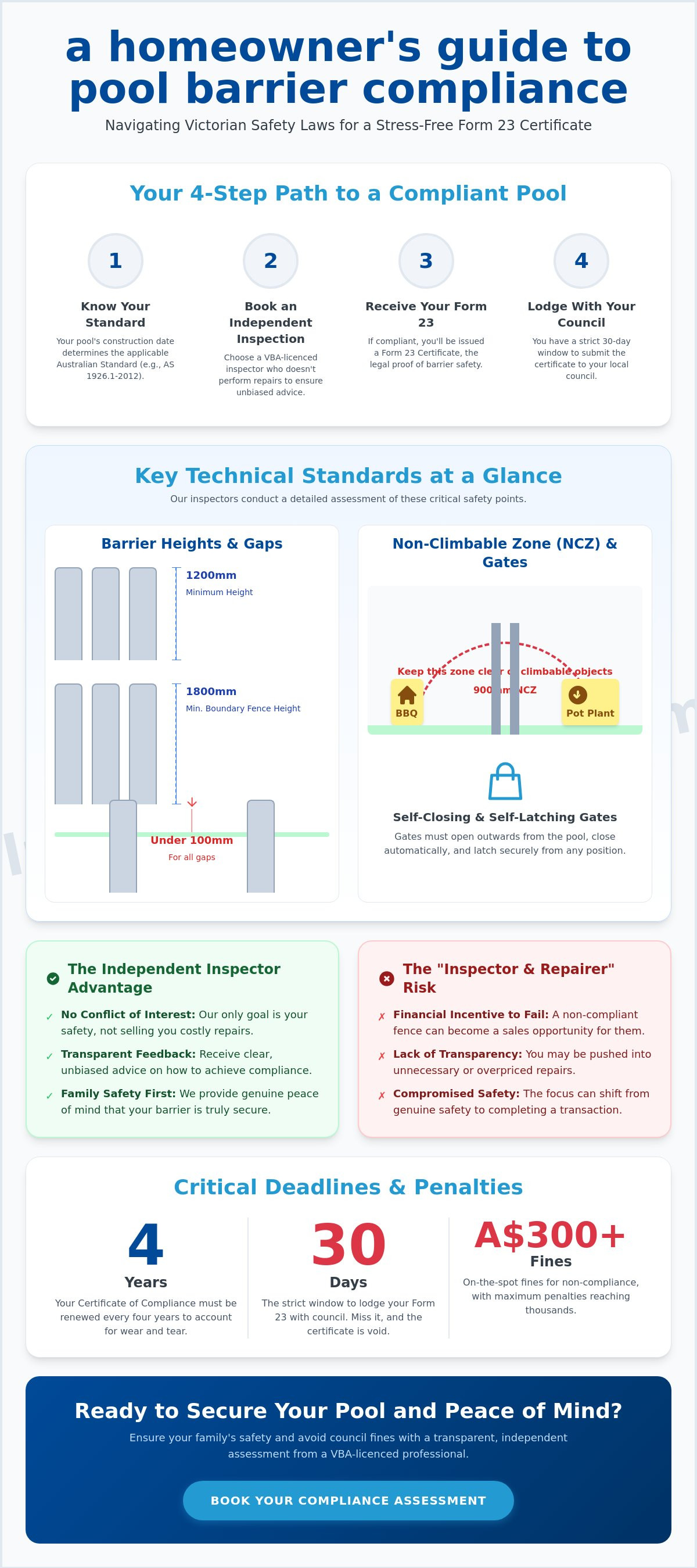
The physical barrier must meet specific dimensional requirements to be deemed compliant. Every fence must maintain a minimum height of 1.2 metres (1200mm) from the finished ground level. If you're using a boundary fence as part of the barrier, that height requirement increases to 1.8 metres (1800mm). Inspectors also measure the "gap" at the bottom of the fence and between vertical pickets. These must never exceed 100mm. Any larger, and a small child could potentially crawl under or squeeze through the barrier. We recommend performing a preliminary check of these measurements before you book your compliance assessment to avoid common failure points.
Mastering the Non-Climbable Zone (NCZ)
The Non-Climbable Zone is a 900mm semicircular arc on the outside of your barrier that must be completely clear of any objects that could facilitate climbing. This is the most frequent cause of failure during a pool fence inspection melbourne. "Climbable objects" include obvious items like chairs or ladders, but also permanent fixtures like garden taps, sturdy tree branches, or even large decorative rocks. For barriers under 1200mm, an additional clear zone of 300mm is often required on the inside of the fence to prevent a child from reaching over and finding a foothold. Ensuring this zone is clear is a vital safeguard for your household.
Gate and Latch Compliance Specifications
Gates represent the most mechanically complex part of your barrier and require rigorous testing. By law, every pool gate must swing outward, away from the pool area, so that a child pushing against it won't accidentally open it. The gate must be self-closing and self-latching from any position, including when it's resting just 10mm off the latch. Inspectors will test the closing force multiple times to ensure the mechanism hasn't lost tension. Latches must typically be located at least 1500mm above the ground or be shielded so they can only be reached by an adult from the inside. If your gate requires a manual "tug" to lock, it's already non-compliant.
The Benefit of Independent Inspections: Why "No Repairs" Means Better Service
Many Melbourne pool owners are surprised to find that a significant portion of the inspection industry also operates as fencing contractors. This "all-in-one" service model creates a fundamental conflict of interest that can compromise the objectivity of your pool fence inspection melbourne. When an inspector stands to profit from the very faults they identify, the line between a legal safety requirement and an unnecessary upsell becomes blurred. By opting for an independent auditor model, you ensure that your barrier is assessed with total impartiality. An independent specialist has no financial incentive to find minor defects or suggest expensive hardware replacements; their sole focus is the rigorous application of Victorian safety standards to protect your household.
Avoiding the Conflict of Interest
Marketing hooks such as "free re-inspections" or "discounted safety checks" are frequently used to funnel homeowners into high-margin repair contracts. These businesses often recoup their initial losses by overcharging for simple gate adjustments or latch replacements. A professional, fixed-fee inspection provides a transparent financial structure that prioritises accuracy over sales targets. This independence ensures a more precise adherence to the safety benchmarks established by the Victorian Building Authority. You receive a definitive, fact-based evaluation of your barrier's structural integrity, ensuring that every safety measure is assessed on its legal merit rather than its potential for repair revenue.
Empowering the Homeowner with Accurate Data
If a barrier fails to meet the required Australian Standard, the quality of the resulting non-compliance report is paramount. An independent inspector provides a technical roadmap that details exactly which components of the fence or gate have failed and why. This level of detail is essential for homeowners who wish to source competitive quotes from their own choice of local fencers or landscapers. It also allows for simple, cost-effective DIY fixes, such as the removal of climbable vegetation or the adjustment of a gate spring, without the pressure of a professional installation fee. Our goal is your safety, not your renovation budget. By arming you with unbiased, expert data, we enable you to navigate the path to compliance with full control over your expenses and total confidence in your family's protection.
Using an independent report ensures that any remedial work is targeted and necessary. You aren't forced to accept a "package deal" that might include hardware you don't actually need. Instead, you hold a professional document that can be used to hold repairers accountable, ensuring that any work performed specifically addresses the faults identified during the initial assessment. This methodical approach is the most efficient way to secure your Form 23 while maintaining the highest safety standards for your pool or spa area.
Pre-Inspection Strategy: How to Pass Your Assessment the First Time
A failed pool fence inspection melbourne is usually the result of minor, preventable oversights rather than major structural flaws. Most homeowners can secure a pass on their first attempt by conducting a rigorous self-audit 48 hours before the inspector arrives. This window allows you to identify "low hanging fruit" compliance issues that frequently trigger a non-compliance report. Weather conditions in Melbourne, particularly the shift between high humidity and dry heat, can cause timber posts to warp or metal gates to shift. These subtle changes often interfere with the delicate balance of your self-closing mechanisms. By systematically checking your barrier's perimeter and mechanical components, you eliminate the risk of a costly re-inspection fee.
The 5-Minute Gate Stress Test
Your gate is the most likely component to fail due to constant use. Begin by opening the gate fully and letting it close; it must latch securely every time. Next, perform the critical "just open" test. Open the gate only 10mm or 20mm and release it. If the spring tension is too weak to pull the latch into the housing from this short distance, the barrier is non-compliant. You should also check for "gate hang," where the bottom of the gate rubs against the ground or the latch post. Finally, with the gate latched, apply significant downward force and shake the gate firmly. If the latch releases under this pressure, the mechanism is faulty and must be adjusted or replaced before your official assessment.
Clearing the Barrier Perimeter
Inspectors look for any object that provides a foothold within the 900mm Non-Climbable Zone. This often includes items homeowners don't consider "climbable," such as BBQ gas bottles, large pot plants, or even decorative garden gnomes. Walk the entire length of your barrier and remove any furniture or storage items within this zone. If you have trees near the fence, ensure no branches thicker than 10mm are within 900mm of the top of the barrier. For windows that open directly into the pool enclosure, you must ensure they cannot open more than 100mm, or they must be fitted with a robust security screen. Taking these steps ensures your property meets the technical requirements of the Building Regulations 2018 without delay.
Preparation is the most effective way to manage your legal obligations. Once you have cleared your perimeter and verified your gate's mechanical integrity, you can book your independent pool barrier inspection with total confidence that your property will meet the required safety standards.
Finalising Your Form 23: The Path to Council Registration
Securing a successful pool fence inspection melbourne is a significant achievement, but the process is not legally complete until the administrative requirements are met. Once our inspector confirms that your barrier meets the applicable Australian Standard, we will issue your digital Form 23 Certificate of Pool and Spa Barrier Compliance. This document serves as the formal verification required by the Building Regulations 2018. While the inspector provides the certification, the legal responsibility to finalise the registration rests solely with the homeowner. Neglecting this final step can result in your property remaining non-compliant on the council's register, despite having a safe and functional barrier.
Submitting Your Certificate to Council
Speed is essential once your Form 23 has been issued. Victorian law dictates a strict 30-day deadline for lodgement with your local council. If you fail to submit the certificate within this window, the document becomes legally void. This requires a completely new inspection to be conducted at your expense to ensure no changes have occurred to the barrier's integrity. Most Melbourne councils, including Monash and Maroondah, provide an online portal for this process. You will be required to pay a lodgement fee, which is set individually by each municipality. We recommend uploading your digital certificate immediately upon receipt to avoid the risk of oversight and the subsequent financial penalties associated with missing the deadline.
Booking Your Melbourne Eastern Suburbs Inspection
Eastern Pool Barrier Compliance provides specialised expertise across Melbourne’s eastern corridor, from Wheelers Hill and Croydon to Ringwood, Rowville, and Vermont. The unique terrain of the eastern suburbs, often characterised by sloping blocks and established gardens, requires an inspector who understands how landscape "creep" affects barrier height and non-climbable zones. We operate as independent auditors, meaning our focus is purely on providing an accurate, unbiased assessment that ensures your family's safety and your property's legal standing. We don't sell repairs, so you can trust that every fault identified is a genuine safety requirement rather than a sales opportunity.
Taking proactive control of your pool safety obligations provides peace of mind and protects you from the heavy fines councils impose for non-registration. Our methodical approach ensures you have a clear, logical path from your initial booking to the final lodgement of your compliance certificate. Book your professional pool barrier inspection today to secure your Form 23 and ensure your pool remains a safe environment for your household.
Securing Your Pool’s Future and Your Family’s Safety
Compliance with the Building Regulations 2018 is a vital obligation for every Victorian homeowner. We've established that the path to a stress-free registration involves conducting your own pre-inspection checks and understanding the specific Australian Standards that apply to your barrier. Selecting an independent auditor is the most effective way to ensure your pool fence inspection melbourne is objective, accurate, and free from the conflict of interest inherent in repair-based services. By focusing on safety rather than hardware sales, you maintain full control over your compliance journey and your budget.
As a VBA Registered Building Surveyor and Inspector, Eastern Pool Barrier Compliance provides the authoritative expertise required to navigate complex council requirements across Melbourne’s eastern suburbs. Our dedicated independent service means you receive a rigorous assessment without the pressure of hidden repair costs or unnecessary upgrades. Secure your Form 23 with a professional Melbourne pool inspection today. You've done the hard work of understanding the rules; now let us provide the professional verification that keeps your family safe and your property legally protected for years to come.
Frequently Asked Questions
How much does a pool fence inspection cost in Melbourne?
Fees for a professional assessment are not regulated by the government and vary between private inspection firms. While industry data suggests initial inspection costs typically range from A$170 to A$400, you should always request a fixed-fee quote that includes the issuance of your compliance documentation. Be aware that re-inspection fees may apply if the barrier fails its first assessment, so choosing an inspector with a transparent pricing structure is essential for managing your budget.
Is a Form 23 the same as a pool safety certificate?
Yes, the Form 23 is the official Certificate of Pool and Spa Barrier Compliance required by Victorian law. It is the only legal document that proves your barrier meets the safety standards mandated by the Building Regulations 2018. Once issued by a registered inspector, this certificate must be lodged with your local council within 30 days to finalise your registration and satisfy your legal obligations for the current four-year cycle.
What happens if my pool fence fails the initial inspection?
If your barrier is deemed non-compliant, the inspector will issue a comprehensive report detailing the specific faults that must be rectified. Under Victorian regulations, you generally have up to 60 days to complete the necessary repairs before a mandatory re-inspection is required. If the safety risks are deemed extreme, or if you fail to address the identified faults within the legal timeframe, the inspector is obligated to notify your local council, which may result in formal fines.
Can I fix my pool fence myself before the re-inspection?
Homeowners are often able to resolve "low hanging fruit" compliance issues, such as removing climbable garden furniture or adjusting gate latch tension, without professional assistance. However, any major structural work or new fence installations should be completed by a qualified tradesperson to ensure the results meet the technical requirements of the Australian Standard. Using the detailed report from your pool fence inspection melbourne allows you to accurately target these fixes and avoid unnecessary expenses.
How long is a pool compliance certificate valid for in Victoria?
A Certificate of Pool and Spa Barrier Compliance (Form 23) remains valid for four years from its date of issue. The Victorian safety registration scheme requires a new inspection every four years to account for factors like ground movement, mechanical wear on gates, or vegetation growth that could compromise the barrier. Maintaining this cycle is a permanent legal requirement for all pool and spa owners in Melbourne to ensure ongoing household safety.
Do I need an inspection for a portable or inflatable spa?
Safety regulations apply to any pool or spa capable of containing water with a depth greater than 300mm. This includes inflatable pools, portable spas, and even some large wading pools that remain in place for more than three days. If your portable vessel meets this depth threshold, it must be enclosed by a compliant safety barrier, registered with your local council, and undergo a formal pool fence inspection melbourne every four years.
How do I find out which Australian Standard applies to my pool?
The applicable standard is determined by the date your pool or spa was constructed or when the barrier was originally installed. When you register your pool with the local council, they will issue a formal letter specifying your "applicable barrier standard," such as AS 1926.1-2012 or the updated AS 1926.1:2024. Your inspector will use this information to conduct a precise assessment tailored to the specific regulations that govern your property's age.
Can my local council fine me if I haven’t registered my pool yet?
Local councils have the authority to issue on-the-spot fines exceeding A$300 for failing to register a pool or spa by the state-mandated deadlines. Councils use property records and aerial mapping to identify unregistered barriers within their municipalities. If you haven't registered your pool, you should do so immediately through your council's online portal to avoid escalating penalties and to receive your scheduled deadline for a mandatory safety inspection.


Comments