Pool Safety Standards Victoria: The Homeowner’s Guide to Compliance in 2026
- J B
- May 20
- 13 min read

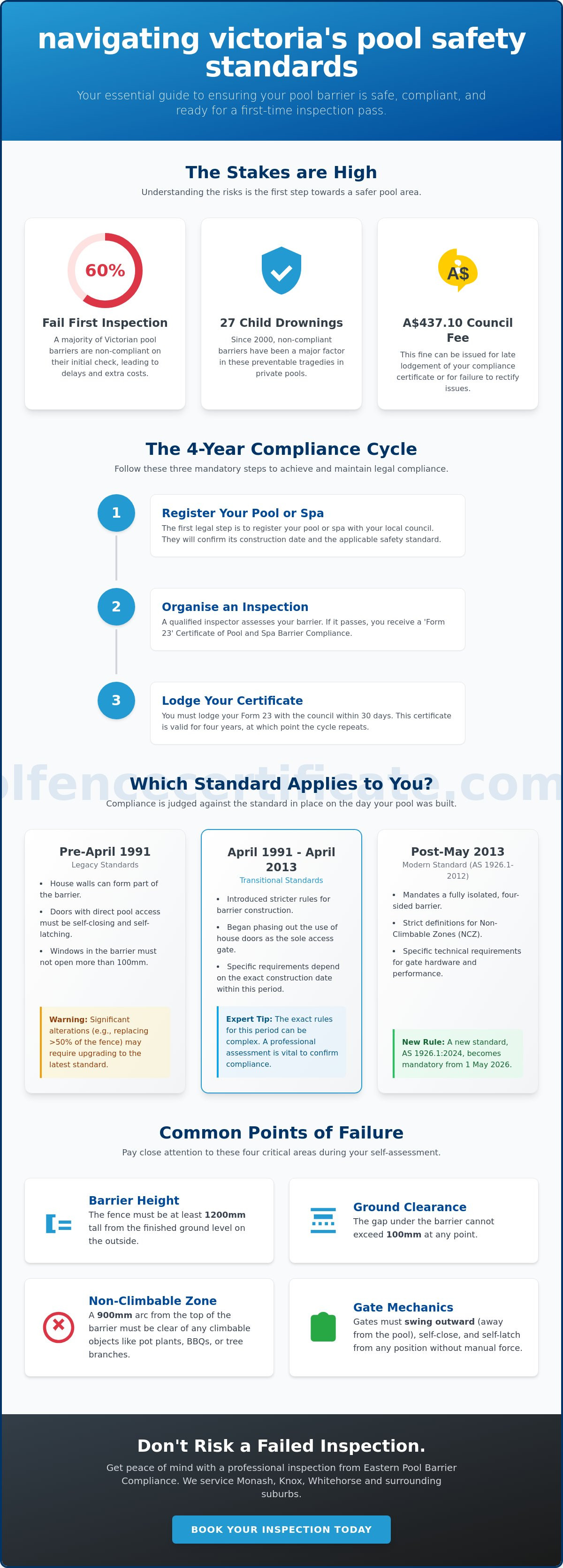
Approximately 60% of Victorian pool barriers fail their first inspection. Since 2000, 27 children have tragically drowned in private pools across the state, with non-compliant barriers cited as a major factor. With the introduction of the AS 1926.1:2024 standard on 1 May 2026, the margin for error has narrowed even further for homeowners. Meeting the current pool safety standards victoria requires more than just a sturdy fence; it demands a precise technical alignment with updated regulations governing gate latches and non-climbable zones. It's understandable if the transition to these new mandates feels overwhelming, especially when a late lodgement or failure can result in a A$437.10 council fee.
We agree that navigating technical jargon shouldn't feel like a legal minefield. This guide simplifies the complexities of Victorian pool safety laws to ensure your barrier meets every mandatory benchmark. You'll gain the clarity needed to pass your inspection on the first visit and successfully lodge your Form 23 Certificate of Pool and Spa Barrier Compliance. We will examine the specific requirements for gate hardware, provide a checklist for the 900mm non-climbable zone, and outline the exact steps to satisfy your local council's requirements.
Key Takeaways
Identify your legal obligations under the 2019 Victorian legislation, including the mandatory four-year inspection cycle for all permanent and relocatable pools.
Determine which specific era of the pool safety standards victoria applies to your barrier to ensure your property meets the precise "Standard of Day" requirements.
Master technical barrier specifications, such as the 1200mm minimum height and 100mm ground clearance, to eliminate common points of non-compliance.
Secure your pool area by verifying gate mechanics, ensuring all gates swing outward and maintain self-closing and self-latching integrity from any position.
Minimise the risk of inspection failure through a strategic self-assessment designed to satisfy local council requirements in Monash, Knox, and Whitehorse.
Table of Contents
Understanding the Legal Framework: Why Pool Safety Standards Matter in Victoria
On 1 December 2019, the Victorian Government introduced a rigorous legal framework to address the risks associated with residential swimming pools and spas. This legislation shifted the burden of proof onto homeowners, requiring them to demonstrate that their safety barriers are maintained to specific benchmarks. Central to this system is the Victorian Building Authority (VBA), which regulates the industry and ensures that only qualified professionals conduct a Pool Barrier Inspection. Adhering to the pool safety standards victoria is a mandatory, ongoing obligation. Every permanent and relocatable pool must undergo a certified inspection every four years. Ignoring these requirements isn't just a safety oversight; it's a legal breach that can lead to council fines exceeding A$1,900 for non-compliance or failing to lodge documentation on time.
The Definition of a Regulated Pool or Spa
The law is precise regarding what constitutes a regulated body of water. Any structure capable of holding water to a depth greater than 300mm (30cm) must have a compliant safety barrier. This includes in-ground pools, above-ground structures, and outdoor spas. Crucially, inflatable and relocatable pools aren't exempt. If you've set up a temporary pool that exceeds the 300mm depth limit, it must be enclosed by a fence that meets the Australian Standard for Swimming Pool Fencing. Hot tubs and swim spas are also subject to these rules, regardless of whether they have a lockable lid or cover.
The Lifecycle of Compliance: From Registration to Form 23
Achieving legal standing involves a specific three-step process designed to ensure total transparency. First, homeowners must register their pool or spa with their local council. The council then confirms which era of the pool safety standards victoria applies based on the construction date. Second, you must arrange a professional inspection. If the barrier passes, you'll receive a Form 23 Certificate of Pool and Spa Barrier Compliance. Finally, this certificate must be lodged with your council within 30 days of issue. This certificate is valid for four years, after which the cycle repeats. Failure to meet these lodgement deadlines can result in a "Notice to Comply," leading to additional inspection costs and potential legal action from your local authority.
Which Standard Applies to You? The Victorian Compliance Timeline
Identifying which version of the pool safety standards victoria applies to your property is the first step toward a successful lodgement. The Victorian Government operates on a "Standard of Day" principle, which means your barrier is assessed against the specific regulations in effect at the time of construction. You can typically find this date on your original building permit, property title, or by requesting records from your local council's building department. The Victorian pool safety barrier regulations categorise compliance into three primary eras: Pre-1991, 1991 to 2010, and Post-2010.
Pre-April 1991: The Legacy Standards
Before 8 April 1991, the rules allowed for greater integration with the home. In these legacy setups, a house wall frequently acted as part of the barrier. This means any doors leading directly into the pool area must be self-closing and self-latching. Windows in these walls must be fitted with sturdy security screens or fixed so they cannot open more than 100mm. While these pools are technically compliant under older rules, we often recommend safety upgrades, such as installing modern shielding, to provide better protection for young children and reduce liability.
It's vital to remember that significant alterations to an existing fence can "reset" your compliance obligations. If you replace more than 50% of your barrier, or if a gate is moved, you're often legally required to upgrade the entire system to meet the most current 2024 standards. This is a common trap for homeowners who attempt DIY repairs without a professional Pool Barrier Inspection to confirm the technical requirements before starting work.
AS 1926.1-2012: The Modern Standard
For pools constructed after 1 May 2013, the AS 1926.1-2012 standard is the benchmark. This era focuses on the "Isolation Barrier" concept, which requires the pool to be completely separated from the house and any other outbuildings. You can't use a back door as an entry point to the pool under this standard. Additionally, boundary fences used as part of the barrier must be at least 1800mm high. This ensures the pool safety standards victoria are maintained from both sides of the property line, preventing children from climbing over from a neighbour's yard.
Navigating these timelines requires precision. A barrier that was compliant ten years ago may now require modifications if the surrounding landscape has changed or if the fence has deteriorated. Ensuring your barrier matches its specific era is the only way to guarantee a pass during your mandatory four-yearly assessment.
Technical Requirements: Non-Climbable Zones and Barrier Height
Precision is the cornerstone of a compliant barrier. Under the current pool safety standards victoria, every fence must maintain a minimum height of 1200mm from the finished ground level. This measurement is not a suggestion; it is a critical benchmark to prevent young children from scaling the structure. Equally important is the ground clearance. Any gap between the bottom of the fence and the ground must not exceed 100mm. This prevents a toddler from crawling under the barrier, a common point of failure in older installations. Beyond height and clearance, the fence must exhibit total structural rigidity. An inspector will apply physical force to ensure the barrier cannot be easily pushed over or moved to create a breach.
Vertical gaps within the fencing itself are strictly regulated. No two vertical members can be more than 100mm apart. This ensures a child cannot squeeze through the panels. To verify your current setup against official checklists, you should consult the Victorian pool safety barrier requirements to ensure your specific materials meet these rigid dimensions.
The 900mm Non-Climbable Zone (NCZ) Explained
The Non-Climbable Zone is a 900mm quadrant on the outside of the barrier that must remain completely clear of any objects that could facilitate climbing. This arc is measured from the top of the fence downwards and outwards. Common NCZ violations that lead to immediate failure include:
Overhanging tree branches or sturdy shrubs.
External taps, power points, or gas meters.
Potted plants, garden furniture, or decorative rocks.
Barbecue equipment or pool pumps positioned too close to the fence.
If a boundary fence is used as part of the pool barrier, it must be at least 1800mm high on the pool side. This height triggers "Additional NCZ" requirements, where a 900mm clear zone must be maintained on the inside of the fence to prevent a child from climbing back out or using internal structures to scale the boundary.
Glass Fencing and Slat Barrier Specifics
Glass barriers offer aesthetic appeal but require diligent maintenance to remain compliant. Hinges must be checked regularly for salt or dirt build-up that could impede the self-closing mechanism. Even a build-up of debris at the base of a glass panel can technically create a "toe-hold" if it reduces the effective height of the barrier. Slat fencing has its own set of rules. If slats are horizontal, the gap between them must be no more than 10mm to prevent them from being used as a ladder. Conversely, vertical slats can have gaps up to 1000mm, provided they meet the overall height and rigidity standards. For mesh or perforated screens, the apertures must be small enough to be anti-climb, typically meaning no opening exceeds 13mm.
Gate Mechanics: The #1 Reason for Inspection Failure
Gates represent the highest risk factor in any safety barrier. Unlike a static fence panel, a gate is a mechanical system subject to constant wear and environmental stress. Under the pool safety standards victoria, every gate must swing outward, away from the pool area. This ensures that a child cannot accidentally push the gate open to gain entry. The most vital rule is that the gate must be "self-closing and self-latching" from any open position. This includes cases where the gate is only open by a few millimetres and is resting against the latch. If the gate fails to engage the latch from a stationary start, the entire barrier is deemed non-compliant.
Melbourne's volatile weather poses a specific challenge to mechanical compliance. Extreme heat and sudden cold snaps can cause metal hinges to expand, contract, or lose spring tension over time. This often leads to a gate that no longer closes with sufficient force to engage the locking mechanism. Regular checks are essential to ensure your hardware remains within legal tolerances. Latch height is another non-negotiable metric; the release mechanism must be positioned at least 1500mm above the finished ground level to remain safely out of reach for small children.
The "Hand-Hole" and Shielding Requirements
If a latch is positioned lower than 1500mm, it must be located on the inside of the gate. To prevent a child from reaching through and operating the latch, the gate must be fitted with a sturdy, non-climbable shield. This shield must have a radius of at least 450mm from the latch mechanism. For glass or slat gates, any hand-hole used to access the internal latch must be no wider than 10mm. These precise dimensions are a common stumbling block during a professional Pool Barrier Inspection, as even a small gap can allow a child's hand to bypass the safety measures.
Common Gate Maintenance for Compliance
Compliance is a continuous state, not a one-time event. You should test your gate weekly by opening it to various widths and letting it close under its own weight. Never prop a gate open with a chair or brick; this is a severe legal breach and an invitation to tragedy. To ensure a smooth inspection, apply a silicone-based lubricant to the latch and hinges. This prevents the friction that often causes a gate to fail the "resting on the latch" test. If your gate drags on the ground or requires a manual pull to lock, it's time to adjust the hardware before your mandatory compliance deadline under the pool safety standards victoria.
Preparing for Your Inspection in Melbourne’s Eastern Suburbs
Approaching your mandatory inspection with a "fix it first" mentality is the most effective way to secure a Form 23 Certificate of Barrier Compliance. A thorough pre-inspection self-assessment allows you to identify obvious hazards, such as climbable garden furniture or gates that don't latch, before a professional arrives. This preparation is vital because the stakes of a failed inspection are high. If an inspector identifies a safety breach, they will issue a written notice outlining the required rectifications. You typically have 60 days to address these issues. If the barrier remains non-compliant after this period, the inspector is legally obligated to lodge a Form 24 Certificate of Non-Compliance with your local council, which can trigger significant penalties.
Understanding the pool safety standards victoria is only half the battle; you must also navigate the administrative requirements of your specific municipality. Residents in Monash, Knox, and Whitehorse face different lodgement portals and fee structures. While the safety standards are uniform across the state, the efficiency of your compliance process depends on following your local council’s registration and lodgement protocols precisely. Failing to lodge your Form 23 within the 30-day window after your inspection will invalidate the certificate, forcing a re-inspection and doubling your costs.
Local Council Dynamics: Wheelers Hill to Croydon
Established suburbs like Glen Waverley, Box Hill, and Wheelers Hill contain a high density of older pools that were built under legacy standards. These properties often require more attention during the preparation phase, as landscaping changes over several decades frequently create new climbable hazards. We encourage every homeowner to visit their specific council’s "Pool and Spa" registration page to confirm their property's "Standard of Day" before booking. Whether you are in Croydon or Ringwood, having your council registration number ready will ensure a seamless transition from the physical assessment to the final lodgement of your compliance documents.
Why Choose an Independent Inspector?
Selecting an independent specialist for your Pool Barrier Inspection or Spa Barrier Inspection is a strategic move to avoid conflicts of interest. Some businesses offer both repairs and inspections, which can lead to biased assessments where minor issues are exaggerated to sell additional services. Eastern Pool Barrier Compliance maintains a strict focus on professional certification and rigorous physical assessments. Our priority is your family's safety and the technical accuracy of your Form 23 Certificate of Pool and Spa Barrier Compliance. We provide a no-nonsense, results-oriented service for homeowners in Ringwood, Rowville, and across the eastern suburbs.
Don't leave your property's legal standing to chance. By conducting a self-assessment and choosing an authoritative guide, you can navigate the pool safety standards victoria with total confidence. Book your Melbourne pool safety inspection today to ensure your barrier is a verified shield for your household.
Secure Your Property and Protect Your Family
Maintaining a compliant barrier is a continuous responsibility that extends far beyond a one-off assessment. By mastering the technical nuances of the 900mm non-climbable zone and ensuring your gate hardware resists the wear of Melbourne's volatile weather, you've taken the first step toward a safer household. Compliance is not merely a box-ticking exercise; it's a precise alignment with the pool safety standards victoria designed to prevent avoidable tragedies. Whether you are navigating the registration portals of Monash or the established property requirements in Whitehorse, the path to a certified barrier is now clear.
You don't have to manage these regulatory burdens alone. Our team of VBA Registered Building Inspectors brings specialised expertise in AS1926.1 standards to every assessment. As specialists in Melbourne’s Eastern Suburbs, we provide the technical accuracy required to satisfy council mandates and protect your family. Secure your Form 23 Certificate with Eastern Pool Barrier Compliance to finalise your safety obligations with efficiency and precision. Take action today to turn your compliance requirements into lasting peace of mind.
Frequently Asked Questions
Do I need a pool safety certificate if I am selling my house in Victoria?
Yes, you must provide a valid Form 23 Certificate of Pool and Spa Barrier Compliance to potential buyers during the sale process. Most conveyancers and solicitors will require this documentation to be included in the Section 32 Vendor Statement. Providing this certificate ensures that the legal responsibility for the barrier is clearly documented and that you are protected from liability regarding non-compliant safety measures at the time of transfer.
Can I use my house wall as part of the pool fence?
The use of a house wall as part of a barrier depends entirely on when your pool was constructed. For pools built before 8 April 1991, a house wall is often permitted as part of the enclosure provided that any doors are self-closing and self-latching and windows are restricted to a 100mm opening. For pools built after this date, the pool safety standards victoria generally require a dedicated isolation fence that separates the pool from the house entirely.
What is the fine for a non-compliant pool fence in Victoria?
Local councils have the authority to issue significant financial penalties for failing to maintain a safe barrier. On-the-spot fines can exceed A$380 for minor infringements, while failing to lodge a compliance certificate or ignoring a "Notice to Comply" can lead to court-imposed penalties of over A$1,900. These costs are avoidable through regular maintenance and timely professional inspections to verify your barrier's integrity.
How high does a pool fence need to be in Melbourne?
A compliant pool barrier must be at least 1200mm high when measured from the finished ground level on the outside of the fence. This is a non-negotiable requirement across all Victorian municipalities. If the ground level is uneven or has been modified with garden beds, the measurement must still reflect a 1200mm vertical rise to ensure the barrier remains an effective deterrent against climbing children.
What happens if my pool fence fails the safety inspection?
If an inspector identifies a breach, they will issue a written notice detailing the specific non-compliance issues. You will typically be granted a 60-day rectification period to bring the barrier up to the required standard. If the issues are not resolved within this timeframe, the inspector is legally required to lodge a Form 24 Certificate of Non-Compliance with your local council, which often results in a fine and further enforcement action.
Do I need a fence for a portable or inflatable pool?
Any pool or spa capable of holding water to a depth of more than 300mm requires a compliant safety barrier. This rule applies regardless of whether the pool is a permanent in-ground structure or a temporary inflatable model purchased from a retailer. If your portable pool exceeds this depth, you are legally obligated to register it with your council and ensure it is enclosed by a fence that meets current pool safety standards victoria.
How long is a pool compliance certificate valid for in Victoria?
A Form 23 Certificate of Pool and Spa Barrier Compliance remains valid for four years from the date of issue. Once this period concludes, you must organise a new inspection with a registered building inspector to obtain a fresh certificate. It is your responsibility to track this expiry date and lodge the new documentation with your local council within 30 days of the inspection to avoid late lodgement fees.
What is a Non-Climbable Zone (NCZ) and why is it important?
The Non-Climbable Zone is a mandatory 900mm clear area on the outside of the barrier that must be free from any objects that a child could use to scale the fence. This zone is critical because even a 1200mm fence can be bypassed if there are nearby trees, taps, or garden furniture that act as a ladder. Maintaining this zone ensures the barrier functions as intended by removing any physical aids that compromise the fence's height.


Comments