Pool Fence Regulations for Rental Properties in Victoria: The 2026 Landlord’s Compliance Guide
- J B
- May 23
- 13 min read

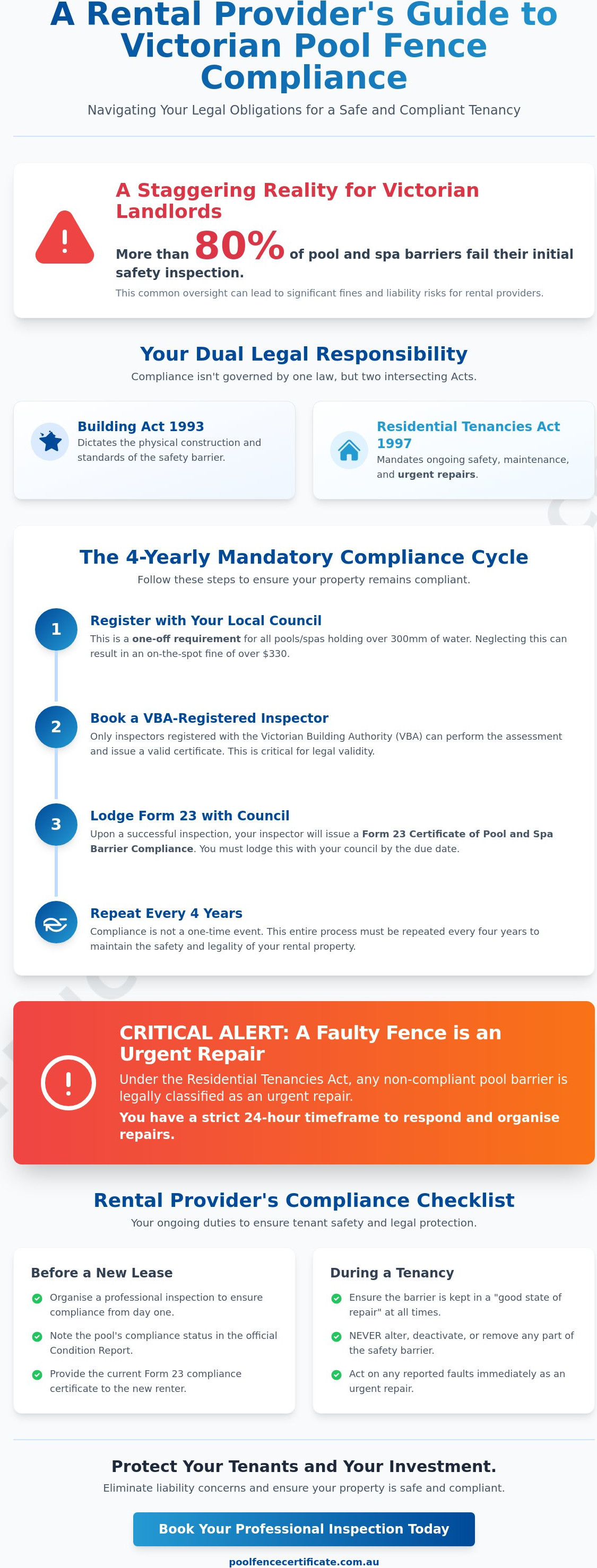
Did you know that more than 80% of pool and spa barriers in Victoria fail to meet safety standards during their initial audit? For rental providers, staying on top of the pool fence regulations for rental properties vic is not merely a recommendation; it is a mandatory legal requirement that carries significant weight under both the Building Act and the Residential Tenancies Act. We recognise that the friction between evolving building codes and your obligations as a landlord often creates a landscape of confusion and legitimate fear regarding council fines or liability.
This guide will help you master the complex intersection of Victorian rental laws and pool safety standards to protect your tenants and your investment. You'll gain access to a clear checklist of landlord duties, a breakdown of the 4-yearly inspection cycle, and the precise steps required for a successful Form 23 lodgement. By the end of this article, you will have the professional clarity needed to eliminate liability concerns and ensure your property remains a safe, compliant environment for every household.
Key Takeaways
Understand how the Building Act 1993 and the Residential Tenancies Act 1997 intersect to create a dual layer of legal responsibility for every Victorian rental provider.
Master the specific pool fence regulations for rental properties vic to ensure your safety barrier meets the correct historical standards and current mandatory requirements.
Learn why a non-compliant barrier is legally classified as an urgent repair, requiring you to respond within a strict 24-hour timeframe to protect your tenants and your investment.
Discover the essential steps for booking a professional assessment and successfully lodging your Form 23 Certificate of Pool and Spa Barrier Compliance with your local council.
Identify your ongoing duty to provide current compliance documentation to renters to ensure transparency and maintain the highest safety benchmarks throughout the tenancy.
Table of Contents
The Dual Legal Landscape for Victorian Rental Pools in 2026
The legal framework governing swimming pools in Victoria underwent a significant transformation that fundamentally changed how property owners manage their assets. If you own a leased property, you are officially recognised as a "Rental Provider" rather than a traditional "Landlord" under the Residential Tenancies Act. This distinction is more than just a change in terminology; it signals a heightened level of accountability regarding safety maintenance. To remain compliant, you must manage the intersection of two distinct pieces of legislation: the Building Act 1993, which dictates the physical construction of your barrier, and the Residential Tenancies Act, which mandates its ongoing safety and immediate repair.
2026 represents a critical juncture for the Victorian property market. Because the mandatory registration and inspection laws were introduced in late 2019, many properties are now entering their second four-yearly inspection cycle. Failure to align with Australian pool fencing laws and the specific Victorian Building Regulations 2018 can lead to immediate council intervention. Understanding the pool fence regulations for rental properties vic is the only way to shield yourself from the legal fallout of a non-compliant barrier. This dual landscape requires proactive management to ensure your investment doesn't become a liability due to outdated safety features.
The Role of the Victorian Building Authority (VBA)
The VBA functions as the state's primary regulator for building and plumbing standards. They oversee the registration of all pool safety inspectors, ensuring that every assessment is conducted with technical precision. It's vital to engage a VBA-registered inspector because only they can issue the Form 23 Certificate of Pool and Spa Barrier Compliance. Standards are not uniform; the specific requirements for your fence depend entirely on when the pool was installed. Whether your pool was built in 1990 or 2020, the VBA standards ensure the barrier remains effective against the risk of young children gaining unsupervised access to the water.
Mandatory Council Registration
Compliance begins with your local government. Every pool or spa capable of holding more than 300mm of water must be registered with the local council. This is a non-negotiable, one-off requirement. Once registered, the council provides a letter confirming the date of construction and the applicable Australian Standard your barrier must meet. This document is the foundation of your compliance journey; it dictates your specific deadline for lodging a certificate. Neglecting this step is the most common trigger for on-the-spot fines of approximately $332.40. Prompt registration ensures you are working toward the correct legal benchmark rather than guessing which pool fence regulations for rental properties vic apply to your specific property.
Mandatory Obligations for Victorian Rental Providers
Compliance is not a static achievement. As a Victorian rental provider, you are legally bound to a cycle of continuous verification and maintenance. While registration with your local Melbourne council is a one-off task, the certification of your barrier is a recurring commitment. Every four years, you must engage a registered inspector to verify that your barrier aligns with the VBA pool safety barrier rules. This process culminates in the lodgement of a Form 23 Certificate of Pool and Spa Barrier Compliance, which serves as your primary shield against legal liability and council penalties.
Your responsibility extends beyond the four-yearly audit. You must ensure the barrier remains in a "good state of repair" at all times. This means that hinges, latches, and fence panels must function perfectly throughout the duration of a tenancy. Adhering to pool fence regulations for rental properties vic requires constant vigilance. You are strictly prohibited from deactivating, altering, or removing any part of a safety barrier. If a component fails, you cannot simply wait for the next scheduled inspection; you must act immediately to restore the barrier's integrity.
Pre-Lease Compliance Checks
The most effective way to mitigate risk is to organise a professional inspection before a new tenant moves in. This ensures that the property is safe from day one. You should explicitly include the pool safety status in the initial Condition Report. Test every gate to ensure it is self-closing and self-latching from any position. Verifying these physical benchmarks early prevents disputes and demonstrates your commitment to tenant safety. If you are preparing a property for the rental market, booking a professional pool barrier inspection is a vital step in your due diligence process.
Disclosure and Documentation
Transparency is a core requirement of the Residential Tenancies Act. You have a legal duty to provide a copy of the most recent Form 23 compliance certificate to your renters at the start of their lease. This document proves that the barrier met the required standards at the time of the last inspection. You must also maintain meticulous records of all maintenance and professional assessments. If your certificate is due to expire during an active tenancy, you must arrange a new inspection and lodge the updated certificate with the council before the deadline. Failure to maintain a current certificate can result in council fines of approximately $332.40, even if the barrier itself is physically sound.
Why a Faulty Pool Fence is Classified as an Urgent Repair
Under the Residential Tenancies Act, a compromised safety barrier is legally classified as an urgent repair. This designation places a heavy burden of responsibility on the rental provider to act with extreme speed. Unlike standard maintenance requests that may have a longer lead time, pool safety faults require an immediate response to mitigate the risk of drowning. Because the pool fence regulations for rental properties vic are so stringent, you don't have days or weeks to consider your options. If a renter notifies you of a defect, you must arrange for repairs to be carried out within 24 hours. This strict timeframe ensures the property remains a secure environment for all occupants, especially young children.
Failing to meet this 24-hour obligation carries severe legal consequences. Renters who find their safety concerns ignored have the right to escalate the matter to the Victorian Civil and Administrative Tribunal (VCAT). VCAT has the authority to issue urgent repair orders, compelling you to fix the barrier at your own expense. Beyond tribunal orders, a neglected fault significantly increases your exposure to liability. If the matter proceeds to court due to negligence, fines can reach up to A$8,059.50. Adhering to pool fence regulations for rental properties vic means acknowledging that a broken latch or a loose fence panel is not just a nuisance; it is a legal emergency that demands your total attention.
Common Faults Triggering Urgent Repairs
Several technical failures will immediately classify a barrier as non-compliant and unsafe. The most frequent issue involves gates that do not self-close or self-latch from every possible open position. If a gate requires a manual push to click shut, it has failed. Similarly, any structural damage that creates a gap larger than 100mm through or under the fence is a critical breach. You must also monitor the Non-Climbable Zone (NCZ), which is a 900mm radius around the barrier. If climbable objects like pot plants, outdoor furniture, or even overgrown branches enter this zone, the barrier's integrity is legally compromised and requires immediate correction.
The Renter’s Duty of Care
While the primary legal responsibility for the barrier's condition rests with the rental provider, renters also have a defined duty of care. They are legally required to notify the provider in writing of any faults as soon as they are identified. Renters must never prop a pool gate open or alter the barrier structure in any way. They are also responsible for ensuring they do not inadvertently create a hazard by placing climbable items near the fence. Clear communication between both parties is essential to maintain safety. However, the final accountability for ensuring the property meets all safety benchmarks remains with the owner.
Navigating the 4-Yearly Inspection and Form 23
Securing a valid compliance certificate is a methodical process that requires strict adherence to chronological steps. While the Residential Tenancies Act focuses on day-to-day safety, the Building Act 1993 mandates a formal audit every four years to ensure structural integrity. This cycle is designed to catch the gradual degradation of safety components, such as weathered hinges or shifting ground levels that affect gate alignment. To maintain your standing under the pool fence regulations for rental properties vic, you must follow a specific sequence of actions to move from registration to verified compliance.
The path to a successful lodgement involves five distinct phases:
Step 1: Confirm your deadline. Contact your local Melbourne council to verify your specific compliance due date. This date is determined by your initial pool registration.
Step 2: Book a professional inspection. Engage a VBA-registered inspector who is authorised to conduct physical assessments and issue formal documentation.
Step 3: Conduct a self-check. Before the inspector arrives, test your gate's self-closing mechanism and ensure no climbable objects have been moved into the 900mm Non-Climbable Zone.
Step 4: The formal audit. The inspector will assess the barrier against the specific Australian Standard applicable to your pool's construction date. If faults are found, you generally have a 60-day window to rectify them.
Step 5: Form 23 lodgement. Once the barrier is deemed compliant, the inspector issues a Form 23. You must lodge this with your council and pay the required lodgement fee, which is approximately A$23.20.
Understanding the Form 23 Certificate
The Form 23, or Certificate of Pool and Spa Barrier Compliance, is the only document that legally proves your barrier meets the required standards. It is important to distinguish this from a Form 24, which is a Notice of Pool Barrier Non-Compliance. If an inspector issues a Form 24, they are legally required to notify the council, which can trigger a significantly higher lodgement fee of approximately A$437.10. Only a registered building surveyor or inspector can issue these documents; a standard handyman or unlicensed contractor does not have the legal authority to certify your property under the pool fence regulations for rental properties vic.
Dealing with Non-Compliance
If your initial inspection identifies defects, you must act decisively within the 60-day rectification period. This window is your opportunity to resolve issues without council intervention. Coordination with your tenants is essential during this time. You must provide proper notice for property access to allow for necessary repairs. If the 60-day period expires without a successful re-inspection, the inspector must issue a Form 24, leading to potential council fines and legal scrutiny. To avoid these complications and ensure a smooth certification process, you should book a pool barrier inspection well in advance of your council deadline.
Ensuring Compliance for Melbourne Rental Properties
Choosing a registered building inspector is a critical decision that impacts both your legal standing and your financial bottom line. To avoid a conflict of interest, it's essential to select an independent provider who does not perform repair work. This independence ensures that your assessment is conducted with total objectivity, as the inspector has no financial incentive to identify unnecessary faults. Eastern Pool Barrier Compliance specialises in this neutral role, providing rental providers across Melbourne with the professional reassurance that their barrier is judged solely against the applicable Australian Standards. In a high-liability rental market, having an unbiased expert on your side is the most effective way to manage the pool fence regulations for rental properties vic.
Securing your property for the 2026 inspection cycle requires a proactive approach. Waiting until the final weeks of your council deadline creates unnecessary stress and leaves no room for the 60-day rectification window if issues are identified. By engaging a specialist who understands the gravity of your legal obligations, you transition from a position of uncertainty to one of verified safety. This methodical verification protects your tenants from physical harm and shields your investment from the heavy penalties associated with non-compliance.
Local Expertise in Melbourne’s Eastern Suburbs
Properties in Glen Waverley, Ringwood, and Rowville often feature a diverse mix of established older pools and modern installations. Each of these requires a different technical lens based on the specific council requirements of Monash, Maroondah, or Knox. Local knowledge is invaluable when assessing how older barriers have shifted over time or how specific council administrative processes might impact your lodgement. We understand the nuances of the eastern suburbs' landscape, ensuring that whether your property is a heritage home or a contemporary build, the inspection is thorough, accurate, and tailored to the local regulatory environment.
Securing Your Form 23 Certificate
The final step in your compliance journey is the issuance and lodgement of your Form 23. Proactive inspections save rental providers money by avoiding the high costs of Form 24 non-compliance notices and council fines. To ensure you meet your upcoming deadline without delay, you should book a pool fence inspection with a VBA-registered professional today. Following this checklist will ensure a stress-free experience:
Verify your registration: Ensure your pool is officially on your local council's register.
Perform a final self-check: Test your gates and clear the 900mm Non-Climbable Zone of any tenant-placed objects.
Secure professional documentation: Obtain your Form 23 immediately following a successful audit.
Lodge and confirm: Pay the council lodgement fee and keep the receipt as part of your permanent rental records.
Adhering to the pool fence regulations for rental properties vic is a manageable process when you partner with the right experts. Taking these steps now ensures your property remains a safe, compliant, and profitable asset for years to come.
Securing Your Rental Property’s Safety and Legal Standing
The intersection of the Building Act 1993 and the Residential Tenancies Act 1997 makes barrier compliance a high-stakes priority for every Victorian landlord. Maintaining a current Form 23 certificate is the only way to demonstrate that you've met your legal duty of care. Remember that any defect in your safety barrier is classified as an urgent repair, requiring an immediate 24-hour response to protect your tenants and your asset. Staying informed about the pool fence regulations for rental properties vic is not just about avoiding council fines; it’s about ensuring the long-term viability of your investment.
As a VBA Registered Building Inspector and specialists in Form 23 compliance, we provide the technical expertise required to navigate these complex mandates. We serve Melbourne’s eastern suburbs with a methodical, results-oriented approach that removes the burden of regulatory paperwork from your shoulders. Don’t leave your legal standing to chance as the 2026 deadlines approach. Ensure your rental property is legal-book your Melbourne pool inspection today. Protecting your property and the families who live there is a shared responsibility that begins with a professional assessment.
Frequently Asked Questions
Who is responsible for the cost of the pool inspection in a rental property?
The rental provider is legally responsible for all costs associated with pool and spa barrier inspections. This includes the professional fee for the VBA-registered inspector and the subsequent council lodgement fee for the Form 23. These expenses are considered essential maintenance costs required to keep the property in a safe and habitable condition under the Residential Tenancies Act; they cannot be passed on to the renter.
Does a relocatable or inflatable pool in a rental property need a fence?
Any water body capable of holding more than 300mm of water requires a compliant safety barrier, regardless of whether it is permanent or relocatable. If a tenant sets up an inflatable pool that exceeds this depth, it must be enclosed by a fence that meets the current pool fence regulations for rental properties vic. Rental providers should clearly outline these restrictions in the lease agreement to prevent unauthorised installations.
How often do I need to get a pool safety certificate for my rental in Victoria?
You must obtain and lodge a Certificate of Pool and Spa Barrier Compliance (Form 23) every four years. This mandatory cycle is established by the Victorian Building Authority to ensure that safety features haven't degraded over time. Failing to lodge this certificate by your local council's specific deadline can result in immediate fines of approximately A$332.40, even if the barrier itself is physically sound.
What happens if my tenant leaves the pool gate propped open?
Renters have a legal duty of care to ensure that pool gates are never propped open or otherwise obstructed. If a tenant is found to be bypassing safety features, they are in breach of their rental agreement and safety obligations. However, the rental provider remains responsible for ensuring the gate's hardware is fully functional and capable of self-closing automatically from any position at all times.
Can a property manager sign off on pool compliance?
No, a property manager cannot legally certify a pool barrier. Only a building inspector or building surveyor registered with the Victorian Building Authority (VBA) has the authority to conduct the formal audit and issue a Form 23. While your property manager can coordinate the booking and manage the documentation, the physical assessment must be performed by a certified technical expert to be legally valid.
What is the fine for having a non-compliant pool fence in Victoria?
Penalties for non-compliance are significant and can escalate quickly. On-the-spot fines for failing to register a pool or lodge a certificate are approximately A$332.40. If a safety breach leads to court proceedings due to negligence, the fines can reach up to A$8,059.50. These financial risks highlight the necessity of strictly following the pool fence regulations for rental properties vic to protect your investment and your tenants.
Do I need a new inspection every time a new tenant moves in?
A new inspection is not legally required for every change of tenancy, provided your current Form 23 is still within its four-year validity period. However, it is a professional best practice to conduct a thorough safety check before a new renter moves in. This ensures the barrier is in a good state of repair and protects you from liability if a fault occurs shortly after the lease begins.
What should I do if my tenant reports a broken pool gate latch?
You must treat a broken gate latch as an urgent repair and arrange for a fix within 24 hours of being notified. Because a faulty gate is a critical safety failure, the Residential Tenancies Act requires immediate action to mitigate the risk of drowning. If you don't act within this timeframe, the tenant has the legal right to escalate the matter to VCAT for an emergency repair order.


Comments