Pool Compliance and Home Insurance Victoria: The 2026 Homeowner’s Guide
- J B
- May 24
- 12 min read

What if a single faulty gate latch could cost you your entire home insurance payout? In 2026, the link between pool compliance and home insurance victoria has never been more critical for Melbourne homeowners. You likely already know that Victorian safety laws are strict, but the financial stakes have shifted from simple council fines to total policy voidance. It's frustrating to keep up with changing mandates, especially when rising premiums are already stretching your household budget. The fear of a claim denial is a heavy burden, but it's one you can eliminate with the right professional guidance.
We understand the pressure of maintaining legal and financial certainty in an increasingly regulated environment. This guide explains how securing a Form 23 Certificate of Pool and Spa Barrier Compliance does more than just satisfy the local council; it acts as a vital safeguard for your property value and insurance standing. You'll discover the exact steps to navigate current requirements, reduce your liability risks, and establish a clear path to a fully certified and protected home. By the end of this article, you'll have a logical plan to ensure your backyard remains a place of relaxation rather than a legal liability.
Key Takeaways
Understand the direct link between the Building Regulations 2018 and your insurance Product Disclosure Statement (PDS) to ensure your coverage remains valid.
Learn how maintaining pool compliance and home insurance victoria is essential to avoiding the "Reasonable Care" clause that allows insurers to deny liability claims.
Identify the financial consequences of non-compliance, where council fines exceeding $1,900 are often the precursor to insurance "good character" reassessments.
Follow a structured path to compliance by identifying which version of the Australian Standard applies to your specific pool or spa construction date.
Discover the benefits of an unbiased, inspection-only approach to securing your Form 23 Certificate of Pool and Spa Barrier Compliance.
Table of Contents
The Intersection of Victorian Pool Regulations and Home Insurance
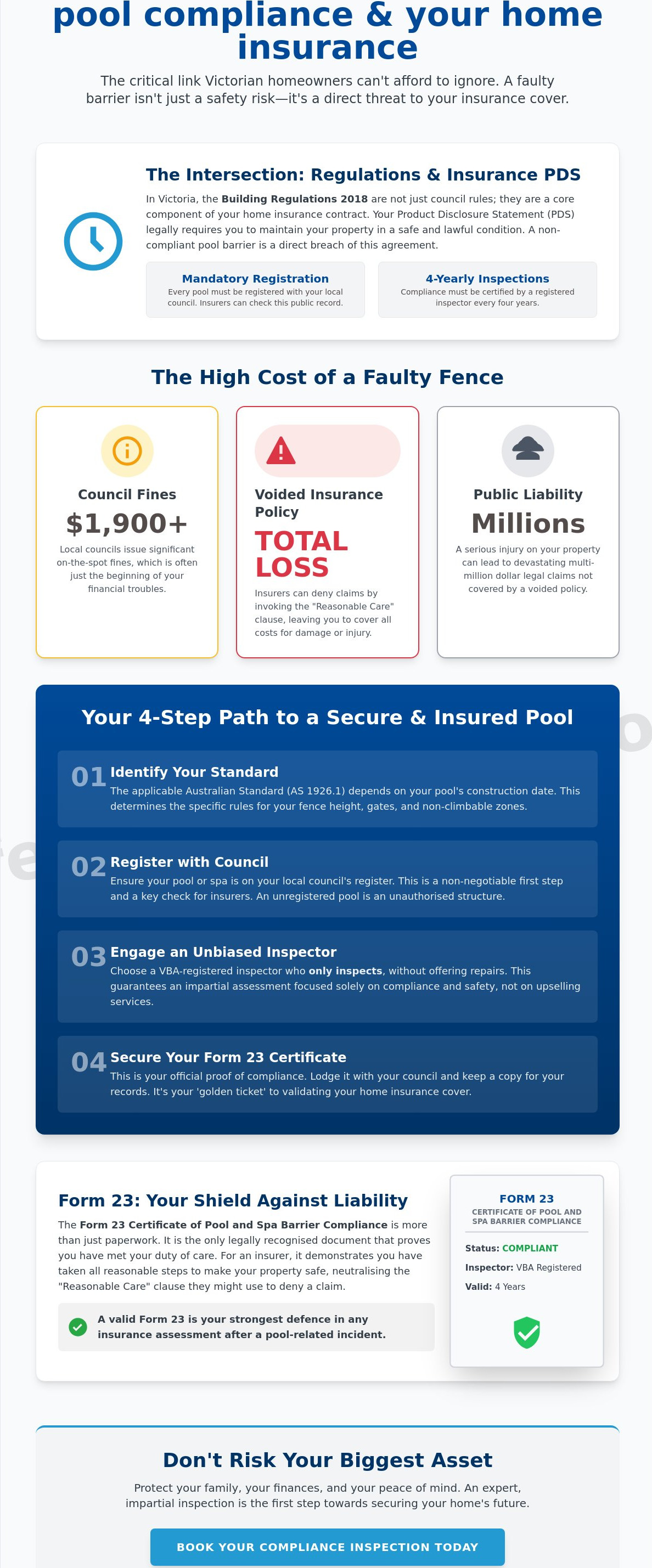
In Victoria, the Building Regulations 2018 serve as the primary legal framework for every backyard swimming pool and spa. These rules aren't merely suggestions for child safety; they are deeply integrated into the fine print of your home insurance Product Disclosure Statement (PDS). When you sign an insurance policy, you enter a contract that requires you to maintain your property in a safe and legal condition. The 2019 legislative changes transformed pool ownership from a passive luxury into a strictly monitored statutory obligation. Every pool must now be registered with the local council and undergo a professional inspection every four years. This creates a permanent, searchable record of your pool's legal status that insurers can access.
Maintaining pool compliance and home insurance victoria is a dual-layered responsibility that protects both your family and your financial assets. Victorian laws align with broader Australian pool fencing standards to ensure a baseline of safety is met across the state. If you fail to meet these standards, you aren't just risking a council fine; you're potentially forfeiting your right to insurance coverage. Insurers view a non-compliant pool as an undisclosed risk. If an incident occurs, the absence of a valid compliance certificate gives the insurer a logical basis to argue that you failed to meet your "duty of disclosure" or "reasonable care" obligations.
Mandatory Registration and Your Policy
Councils across Melbourne's east, from Manningham to Maroondah, are actively auditing their databases to identify unregistered pools and spas. If your pool isn't on the official register, it is technically considered an unauthorised structure. Most insurance policies include "lawful occupation" or "statutory compliance" clauses. This means the insurer may refuse to cover incidents occurring in or around structures that don't meet state legal requirements. Failing to register your pool provides an insurer with a direct reason to deny a claim, as the property no longer meets the legal description provided when the policy was issued. Your registration status is the first thing an assessor will check following a backyard accident.
The Form 23: Your Golden Ticket to Coverage
A Form 23 Certificate of Pool and Spa Barrier Compliance is the only document that proves your barrier meets the specific legal standards applicable to its construction date. It must be issued by a Victorian Building Authority (VBA) registered inspector after a rigorous physical assessment. It's vital to distinguish between a casual "safety check" and this statutory document. A safety check holds no legal weight with the council or your insurer. During a claim for a pool-related injury or property damage, an insurer will likely demand a copy of your Form 23 to verify your due diligence. This certificate acts as your shield, proving you've taken every necessary step to secure your home and stay within the law.
How Insurers Evaluate Pool Safety Barriers in Melbourne
Home insurance isn't a blanket safety net that covers every incident regardless of the circumstances. When an insurer evaluates a property with a pool or spa, they look specifically at the risk profile of the safety barrier. Most standard home and contents policies include public liability coverage, which is designed to protect you against multi-million dollar legal claims if someone is injured on your property. However, this coverage is contingent upon your adherence to the "Reasonable Care" clause found in almost every Product Disclosure Statement (PDS). If your gate doesn't latch or your fence has been compromised, an insurer can argue you failed to take reasonable steps to prevent harm.
Understanding the connection between pool compliance and home insurance victoria is essential for maintaining your financial security. Insurers distinguish between "Total Loss" claims, which cover physical damage to the pool structure from events like storms, and "Liability" claims, which involve human injury. While property damage is a significant concern, liability claims are often far more costly and legally complex. A failure to register your pool or maintain a current compliance certificate could affect your home insurance by giving the provider a valid reason to void your liability protection entirely.
Public Liability and the Non-Compliant Barrier
The financial reality of a liability claim is staggering. If a drowning or serious injury occurs in a non-compliant pool, the homeowner may be held personally liable for damages that can reach into the millions. Following such an incident, insurance assessors will perform a forensic investigation of the barrier. They check for faulty gate latches, holes in the mesh, or climbable objects within the Non-Climbable Zone (NCZ). In the eyes of the law and your insurer, "I didn't know the gate was broken" is not a valid defence. You're legally required to ensure your barrier works every single day, not just on the day of your inspection.
Premium Discounts for Certified Safety
While non-compliance carries heavy risks, proactive safety measures can sometimes work in your favour. Some Australian insurers are beginning to refine their risk grading based on documented safety benchmarks. By notifying your insurer that you hold a current Form 23, you demonstrate that your property is a lower risk compared to uncertified homes. This is particularly vital for investors, who should prioritise pool fence regulations for rental properties vic to safeguard their assets and satisfy their landlord insurance requirements. Taking the time to organise a professional barrier inspection is the most effective way to provide your insurer with the proof of due diligence they require.
The Financial Risks of Non-Compliance: Claims, Liability, and Fines
The financial burden of owning a pool in Melbourne extends far beyond seasonal maintenance and heating costs. Many homeowners view the expense of a pool fence inspection melbourne as a discretionary cost. This perspective ignores the catastrophic financial exposure of a rejected insurance claim. In the current 2026 regulatory climate, a non-compliant barrier is a liability that can devalue your home and complicate any future sale. A valid Form 23 is now a standard expectation in a Section 32 vendor statement; without it, you risk alienating buyers and facing mandatory rectification orders that can delay settlement by months.
Maintaining pool compliance and home insurance victoria is the only logical strategy to protect your household from total financial loss. If you develop a history of ignoring council directions or failing to lodge your compliance certificate every four years, you may find your property becoming effectively uninsurable. Insurers are increasingly sharing data with regulatory bodies. A "Notice of Non-Compliance" on your record acts as a permanent red flag during risk assessments. This can lead to significantly higher premiums or a flat refusal to renew your policy, leaving your most valuable asset unprotected.
The Cost of a Rejected Insurance Claim
Consider a scenario where a visitor enters the pool area because a gate failed to self-close. If the subsequent investigation reveals the latch was faulty, your insurer will likely exercise the "Reasonable Care" clause to deny the claim. You are then personally responsible for legal fees, medical expenses, and potential long-term care costs. Without the backing of your public liability insurance, these expenses often lead to personal bankruptcy. Insurers are more rigorous than ever in 2026, using forensic assessments to ensure every barrier meets the specific Australian Standard required by law.
Council Fines and Legal Standing
The Victorian government has established a clear hierarchy of penalties to enforce safety. Failing to lodge a compliance certificate can result in an on-the-spot fine of up to $1,923.10. However, the legal trouble does not end there. If an inspector issues a Form 24 (Notice of Non-Compliance), the local council is notified immediately. This triggers a legal process that requires rectification within a strict 60-day window. If you fail to comply, the fines can escalate to over $9,600 for repeated or serious breaches. These legal marks on your property file are visible to insurers, who interpret them as a failure of property management, further jeopardising your coverage.
Step-by-Step: Securing Your Home Insurance Validity via Compliance
Securing your property requires a methodical approach to satisfy both state law and insurance underwriters. The relationship between pool compliance and home insurance victoria is built on documented proof of safety. You cannot simply assume your barrier is safe; you must verify it against the specific standards that apply to your property's history. This process moves from initial research to formal certification, ensuring your policy remains a robust safety net rather than a voided contract.
Determining Your Applicable Safety Standard
The age of your pool dictates which version of the Australian Standard (AS 1926) your inspector will use. Pools built before 8 April 1991 operate under different regulations compared to those constructed in 2026. Locating your original building permit date is the first step in this process. This date determines the requirements for your Non-Climbable Zone (NCZ), which is a 900mm area around the barrier that must be free of climbable trees, shrubs, or furniture that could facilitate unauthorised access.
The Professional Inspection Process
When you engage Eastern Pool Barrier Compliance, our inspectors conduct a rigorous physical assessment of your gate, fence, and surrounding environment. We often find that simple, overlooked items lead to failure. Moving pot plants, garden benches, or low-hanging branches away from the fence can often turn a non-compliant barrier into a compliant one. Once the inspection is complete and the barrier is verified, you will receive your Form 23 Certificate of Pool and Spa Barrier Compliance. This process is efficient and designed to provide immediate legal clarity.
Once you hold your Form 23, you must lodge it with your local council, such as the City of Knox, Monash, or Maroondah, within 30 days of the inspection date. If you miss this window, the certificate becomes invalid and the entire assessment process must restart. After the council acknowledges your lodgement, your final task is to contact your home insurance provider. Inform them that your property now holds a current statutory compliance certificate. This final step ensures that the link between pool compliance and home insurance victoria is fully formalised, protecting your policy from "reasonable care" disputes. To begin this process, you should book a professional barrier inspection with a registered specialist today.
Expert Pool Barrier Inspections: Your Shield Against Liability
Choosing an inspection-only specialist is a strategic decision that eliminates the conflict of interest inherent in repair-based businesses. Eastern Pool Barrier Compliance focuses exclusively on pool barrier and spa barrier inspections, ensuring that your assessment is conducted with total impartiality. We don't profit from finding faults that require expensive repairs; our only objective is to verify that your property meets the relevant Australian Standards. This unbiased approach provides the absolute legal and financial certainty required to maintain the link between pool compliance and home insurance victoria. When our inspectors issue a Form 23, it stands as a definitive, certified statement of safety that both councils and insurers trust.
While the regulatory landscape is complex, the underlying driver for every professional assessment is the preservation of life. In the year ending 30 June 2024, 15 children under the age of five lost their lives to drowning in Australia, with half of these incidents occurring in private swimming pools. These statistics underscore the gravity of your responsibility as a homeowner. A compliant barrier is more than a box-ticking exercise for your insurance policy; it is a vital safeguard for your family and the wider community. Our role is to act as your knowledgeable guide, taking the burden of compliance off your shoulders and providing you with genuine peace of mind.
Serving Melbourne’s Eastern Suburbs
Our team possesses a deep understanding of the specific local council requirements across Melbourne’s east, including Wheelers Hill, Vermont, and Box Hill. We recognise that homeowners in Dandenong and Narre Warren often face complex barrier layouts that require a seasoned eye to navigate effectively. If you are facing a looming insurance renewal or a property sale deadline in Glen Waverley, Ringwood, or Croydon, we prioritise efficiency. We provide fast turnaround times for our inspections and the subsequent issuance of Form 23 documentation, ensuring you never miss a critical 30-day lodgement window.
Take Action for Your Home and Family
The process of securing your 2026 compliance certificate is straightforward and methodical. By engaging a VBA-registered professional, you move from a position of potential liability to one of verified safety. Remember that in the eyes of an insurer, a current certificate is the best evidence of your due diligence. It effectively closes the door on "reasonable care" disputes and protects your household from the catastrophic costs of a rejected claim. Don't leave your most valuable asset exposed to unnecessary risk. Protect your home and ensure compliance today by booking your professional barrier assessment with our expert team.
Secure Your Financial Future and Family Safety Today
Victorian homeowners can't afford to treat backyard safety as a secondary concern. The direct link between pool compliance and home insurance victoria means that your property's legal status is now a fundamental component of your financial security. By securing a Form 23, you satisfy council mandates and provide your insurer with the documentation required to uphold your public liability coverage. Failing to act risks more than just a council fine; it puts your entire household at risk of unrecoverable financial loss.
Our team of VBA Registered Building Inspectors provides a dedicated, inspection-only service throughout Melbourne’s eastern suburbs. We don't perform repairs, which ensures our assessments remain completely unbiased and focused solely on your safety. This professional clarity allows you to move forward with absolute certainty that your barrier meets the required Australian Standards. We understand the intricacies of local mandates and take the burden of certification off your shoulders.
Don't leave your insurance validity to chance. Take the final step toward total property protection and Book Your Professional Pool Barrier Inspection Today. Ensuring your backyard is a safe haven for your family is a responsibility we are ready to help you meet with precision and care.
Frequently Asked Questions
Will my insurer pay out if my pool gate was propped open during an accident?
Your insurer is highly likely to deny any claim if a gate was intentionally propped open. This action constitutes a direct breach of the "reasonable care" obligation found in your Product Disclosure Statement (PDS). Because you have a legal responsibility to ensure the barrier is effective at all times, propping the gate open is viewed as negligence. This voids your public liability protection and leaves you personally liable for damages.
Does my home insurance cover the cost of pool fence repairs required for compliance?
Home insurance does not cover the costs associated with upgrading or repairing a barrier to meet Victorian safety standards. Policies are designed to protect against sudden and accidental events, such as storm damage or fire. Maintenance, wear and tear, or the rectification of non-compliant features are the sole financial responsibility of the homeowner. These costs are never covered by standard property insurance policies.
How do I know if my pool is registered with the local council in Melbourne?
You can verify your registration status by contacting the building department of your local council or checking their dedicated online property portal. Most councils in Melbourne's east now provide a searchable database for residents. If your pool or spa was built before November 2020 and you haven't yet registered it, you are currently in breach of state law. You must rectify this immediately to avoid significant on-the-spot fines.
Can I get insurance for a property with a non-compliant pool?
Securing a policy for a property with a non-compliant pool is possible, but your liability coverage will be severely compromised. Insurers require you to disclose the true state of your property; failing to mention a non-compliant barrier can be viewed as a failure of your duty of disclosure. Maintaining pool compliance and home insurance victoria is the only way to ensure your policy remains enforceable in the event of a backyard incident.
What is the difference between a Form 23 and a Form 24 in Victoria?
A Form 23 is a Certificate of Pool and Spa Barrier Compliance, which is the official document proving your barrier meets the required safety standards. In contrast, a Form 24 is a Notice of Non-Compliance. This is issued by an inspector when a barrier fails to meet the standards and the issues aren't rectified within the allowed 60-day window. Receiving a Form 24 triggers a formal council enforcement process and potential penalties.
How often do I need to update my pool compliance certificate for my insurer?
Victorian law requires you to have your barrier inspected and a new certificate lodged with the council every four years. While the council tracks this cycle, you should provide a copy of your new Form 23 to your insurer as soon as it's issued. This proactive step confirms to your provider that you're meeting your statutory obligations. It proves you are maintaining the property in a safe, insurable condition according to current mandates.
Does insurance cover the $1,900+ council fines for non-compliant barriers?
Insurance policies never cover fines, penalties, or infringement notices issued by government authorities or local councils. These costs are considered personal liabilities resulting from a failure to follow the law. If you're fined up to $1,923.10 for failing to lodge a compliance certificate, that expense must be paid out of your own pocket. It cannot be claimed under any standard home and contents policy in Australia.


Comments