Do I Need a Fence Around My Spa in Vic? The 2026 Compliance Guide
- J B
- May 22
- 12 min read

That lockable, heavy-duty lid on your new outdoor spa might feel like a fortress; however, according to Victorian law, it is legally invisible. Many homeowners ask, "do i need a fence around my spa vic" while pointing to a reinforced cover, only to discover that the 300mm rule makes no exceptions for lids or portable models. It is a high-stakes misunderstanding that can lead to significant council fines and, more importantly, preventable safety risks for your family.
We understand that navigating the dense regulatory jargon of the Victorian Building Authority (VBA) is often overwhelming. You want to ensure your home remains a safe sanctuary without falling foul of complex legislative updates or unexpected audits. This 2026 guide provides the clarity you need, detailing exactly when a permanent safety barrier is mandatory and how to achieve a Form 23 Certificate of Pool and Spa Barrier Compliance. We will outline the current Australian Standards, the mandatory registration requirements, and the specific inspection roadmap required to protect your household and satisfy local council mandates.
Key Takeaways
Understand why any vessel capable of holding more than 30cm of water requires a permanent safety barrier under the Building Regulations 2018.
Identify the legal triggers for answering "do i need a fence around my spa vic" and why lockable lids are never an acceptable substitute for a compliant barrier.
Master the technical specifications for compliance, including the mandatory 1200mm height and the 900mm Non-Climbable Zone requirements.
Navigate the mandatory council registration process and the four-year inspection cycle required to obtain your Form 23 Certificate of Pool and Spa Barrier Compliance.
Learn how to prepare for a professional spa barrier inspection to avoid costly council fines and ensure the long-term safety of your household.
Table of Contents
Victoria’s Spa Fencing Laws: The Absolute Requirements
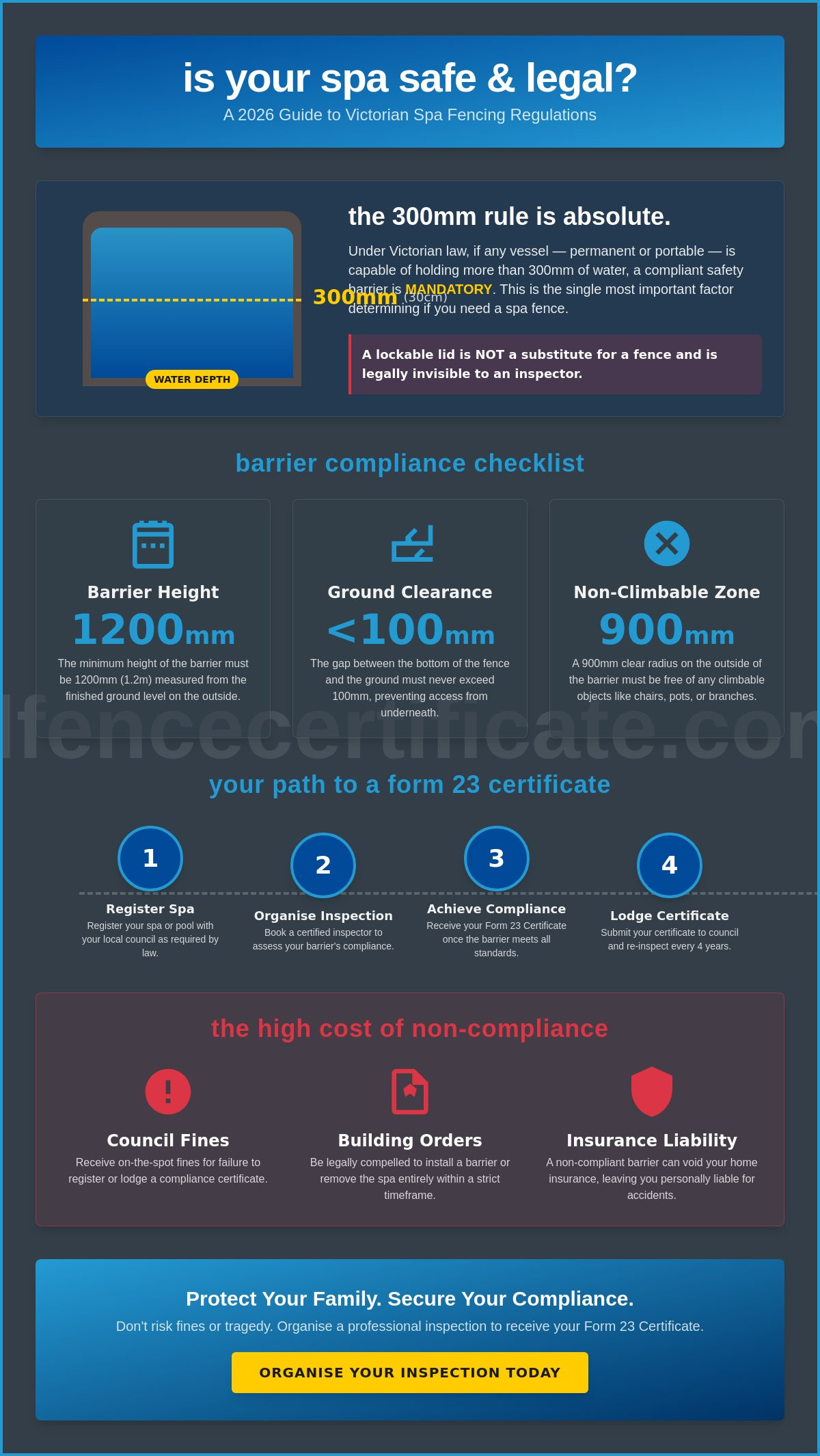
The legal framework governing your backyard oasis is found within the Building Act 1993 and the Building Regulations 2018. These laws are not mere suggestions; they are rigid safety mandates designed to prevent tragedy. If you are asking, "do i need a fence around my spa vic", the answer is almost always a definitive yes. Victorian law defines a "spa" broadly, encompassing traditional hot tubs, swim spas, and even relocatable vessels. Under Part 9A of the Regulations, any structure intended for swimming, wading, or paddling that can hold more than 300mm of water must have a compliant safety barrier.
Many homeowners believe that a "temporary" or "portable" status grants an exemption from these rules. This is a dangerous misconception. The law focuses on the depth of the water and the potential risk, not the material of the vessel. Whether your spa is a permanent concrete installation or a retail inflatable, it must be protected by a barrier that meets Australian pool fencing standards. Failure to recognise this obligation places your household at risk and leaves you vulnerable to severe legal repercussions.
The 300mm Rule Explained
The 300mm rule is the primary benchmark for compliance in Victoria. It is vital to understand that this depth is measured from the lowest point of the spa floor to the top of the vessel wall. It does not matter if you only intend to fill the spa to 200mm; if the structure is capable of holding more than 30cm of water, a barrier is mandatory. This strict standard exists because an average of four young children die in Victorian home pools or spas every year. Even a small inflatable spa bought from a department store can pose a fatal drowning risk, which is why the Victorian Government enforces these mandates without exception for "portable" models.
Consequences of Non-Compliance in 2026
Local councils across Melbourne are currently conducting rigorous audits to ensure every property with a spa is registered and compliant. If your barrier is found to be non-compliant, the financial and legal fallout is significant. You may face the following:
Council Fines: Local authorities can issue on-the-spot fines for failing to register your spa or failing to lodge a Form 23 Certificate of Barrier Compliance.
Building Notices and Orders: A Municipal Building Surveyor may issue a formal Building Order, legally compelling you to install a barrier or remove the spa entirely within a strict timeframe.
Insurance Liability: Most home insurance policies in Victoria require you to maintain your property according to all relevant laws. A non-compliant spa barrier could void your liability coverage, leaving you personally responsible for any accidents or injuries that occur on your property.
Property owners often struggle with the question, "do i need a fence around my spa vic", particularly when dealing with relocatable models. However, the legal reality in 2026 is clear: if it holds water deeper than 30cm, the barrier is a non-negotiable requirement for your safety and legal standing.
Technical Specifications for a Compliant Spa Barrier
Determining "do i need a fence around my spa vic" is only the first step; the second is ensuring that barrier meets the rigorous AS 1926.1-2012 standard. A compliant spa barrier must be a permanent structure designed to restrict access by young children. The primary requirement is a minimum height of 1200mm, measured from the finished ground level on the outside of the fence. Ground clearance is equally critical. The gap between the bottom of the barrier and the ground must not exceed 100mm at any point, preventing a child from crawling underneath. According to the VBA safety barrier requirements, these measurements are non-negotiable and must be maintained throughout the life of the spa.
If you are unsure whether your current setup meets these engineering benchmarks, a professional spa barrier inspection provides the certainty needed to avoid legal liability. Our assessors identify specific failures that are often invisible to the untrained eye, ensuring your household remains protected and compliant with Victorian law.
The Non-Climbable Zone (NCZ) Essentials
The Non-Climbable Zone is a 900mm clear radius on the outside of the barrier that must be free of any "climbable objects." Common failures in Melbourne backyards include placing pot plants, garden chairs, or even low-hanging tree branches within this zone. If a child can use an object to gain a foothold, the barrier is legally non-compliant. While you can use a boundary fence as part of your spa barrier, it must be at least 1800mm high on the inside to meet the required safety standard. Maintaining this clear zone is one of the most frequent challenges for property owners during an audit.
Gate and Latch Standards
The gate is the most active part of your safety barrier and is subject to strict mechanical requirements. It must always open outwards, swinging away from the spa area, to ensure that any child leaning against it does not accidentally push it open. Additionally, the latching mechanism must be positioned at least 1500mm above the ground. You should regularly test the self-closing mechanism; the gate must shut and latch securely from any position, even when it is resting just millimetres from the latch. A gate that fails to self-close or requires manual assistance is a major safety breach and a primary cause of inspection failure.
Mandatory Registration and the Form 23 Process
Registration is the critical first step in meeting your legal obligations as a property owner in Victoria. Under the Building Regulations 2018, every permanent or relocatable spa must be registered with the local council. Whether you reside in the City of Monash, Knox, or Whitehorse, the registration process creates a formal record of your safety barrier's existence. This administrative requirement ensures that local authorities can track compliance across the state. If you are still questioning, "do i need a fence around my spa vic", the registration process will provide a definitive answer by identifying the specific safety standard applicable to your property based on the spa's installation date.
Following the initial registration, the Victorian Government mandates a four-year inspection cycle. This recurring obligation requires you to engage a registered building surveyor or a pool safety inspector to assess your barrier. Upon a successful audit, the inspector issues a Form 23 Certificate of Pool and Spa Barrier Compliance. This document serves as legal proof that your safety measures meet the Victorian Government's official spa barrier regulations. Failing to lodge this certificate within the specified deadlines can result in significant council penalties and legal liability.
How to Register Your Spa with Council
To begin the process, you must notify your local council through their online portal or a physical application form. You will need to provide the date the spa was constructed or installed and pay a one-off registration fee. For spas built before November 2020, the fee typically ranges from $87.20 to $90.40, while newer installations built after that date cost approximately $36.80. Relocatable spas attract a fee of roughly $59.30. Once processed, the council will send you a formal letter confirming the "applicable barrier standard" for your spa. This document is essential for your inspector to conduct an accurate assessment.
Securing Your Form 23 Certificate
The inspection process results in one of two outcomes: a Certificate of Compliance (Form 23) or a Notice of Non-Compliance. If your barrier fails to meet the required standard, the inspector will issue a written notice detailing the necessary rectifications. You then have a strict 60-day window to complete these repairs. Once the barrier is brought up to standard, a follow-up inspection is performed to issue the Form 23. You must lodge this certificate with your council along with a lodgement fee of approximately $23.20. Procrastination in this area is costly; the fee for lodging a certificate of non-compliance is significantly higher, often reaching $437.10, and may trigger further enforcement action.
Debunking the "Lockable Lid" and Portable Spa Myths
Misinformation regarding spa safety is prevalent in online community forums, often leading to dangerous legal exposure for Victorian homeowners. One of the most persistent questions we encounter is, "do i need a fence around my spa vic if it has a lockable lid?" The answer from the Victorian Building Authority is an unequivocal yes. A lockable lid is classified as an accessory or a safety cover; it is never a substitute for a permanent, compliant barrier. Relying on a lid alone leaves you non-compliant with the Building Regulations 2018 and vulnerable to heavy council penalties.
Similarly, the "indoor spa" myth suggests that the walls of your home automatically constitute a legal barrier. While house walls can form part of a barrier, any door leading directly from the house into the spa area is generally prohibited under modern standards. These doors represent a significant point of failure. In almost every residential scenario, a separate internal fence is required to isolate the spa from the living quarters, ensuring a child cannot wander from the lounge room directly into the water.
Why Lids Fail the Compliance Test
The primary reason lids are rejected as legal barriers is the high risk of human error. Lids are frequently left unlocked, partially retracted, or propped open for ventilation. A compliant barrier must be a "passive" safety device that works without human intervention, such as a self-closing and self-latching gate. Additionally, many spa covers lack the structural integrity required by Victorian law. Over time, foam cores degrade and vinyl becomes brittle. This means a lid might not support the weight of a child who climbs onto it. Under the National Construction Code, a barrier must be a fixed, vertical structure that cannot be easily bypassed or removed.
Portable and Inflatable Spa Rules
Drowning risks don't change based on whether a spa is permanent or "plug-and-play." If your inflatable or portable spa can hold more than 30cm of water, it is subject to the same $19,000+ maximum court-imposed fines as a permanent concrete installation. Many owners are also surprised to learn that a building permit is often required to install the safety barrier itself, even if the spa was purchased from a retail store. The "temporary" nature of these vessels is irrelevant in the eyes of the law. If the water is there, the fence must be too.
To ensure your setup is legally sound and physically safe, book your spa barrier inspection with a qualified professional who understands the nuances of Victorian mandates and can help you avoid these common pitfalls.
Organising a Professional Spa Inspection in Melbourne
Once you have confirmed the answer to "do i need a fence around my spa vic", the focus must shift to professional verification. Engaging an independent inspector is the most reliable way to ensure your property meets the required safety standards without bias. It is vital to choose an assessor who does not perform fence repairs or installations. This separation of services eliminates any conflict of interest; you can trust that our findings are based solely on regulatory compliance rather than an attempt to upsell additional construction work. Our role is to provide a transparent, accurate assessment that prioritises the safety of your household.
Before your scheduled audit, we recommend performing a preliminary self-check of your barrier. Verify that your gate swings freely and latches securely from any open position. Ensure the 900mm Non-Climbable Zone is clear of garden furniture or climbable vegetation. By addressing obvious faults early, you increase the likelihood of passing the initial inspection and receiving your Form 23 Certificate of Pool and Spa Barrier Compliance without the need for a 60-day rectification period. Eastern Pool Barrier Compliance specialises in this meticulous assessment process, guiding you through the technical requirements with professional precision.
The Eastern Suburbs Compliance Specialist
Our team provides specialised services across Melbourne’s Eastern Suburbs, including Glen Waverley, Ringwood, and Box Hill. We possess deep expertise in navigating the specific registration and lodgement requirements of local councils such as Monash, Knox, and Whitehorse. Every backyard layout in the East is unique, and our inspectors are trained to apply the Victorian Building Authority’s standards to your specific site conditions. We take the burden of compliance off your shoulders, acting as a vigilant protector for your family and a reliable partner in your dealings with local government authorities.
Book Your Inspection Today
Procrastination is a significant risk when dealing with mandatory safety mandates. Council audits are increasing in frequency, and failing to lodge your certificate on time can lead to avoidable legal complications. Being proactive is the only way to safeguard your home against liability and ensure your spa remains a place of relaxation rather than a legal hazard. We offer a streamlined process for spa barrier inspections in Melbourne, designed to provide you with peace of mind through rigorous adherence to the law.
Confirm your gate is self-closing and self-latching.
Clear all climbable objects within 900mm of the barrier.
Check that ground clearance does not exceed 100mm.
Ensure your council registration letter is available for the inspector.
Secure your property and protect your loved ones by choosing a professional assessment that leaves no room for error. When you are ready to move beyond the question of "do i need a fence around my spa vic" and secure your formal compliance, our team is ready to assist.
Secure Your Compliance and Household Safety
Navigating the legal landscape of Victorian spa safety requires more than just a sturdy cover; it demands rigorous adherence to the Building Regulations 2018. The definitive answer to do i need a fence around my spa vic is established by the 300mm depth rule, which applies to every vessel regardless of its portable or permanent status. By understanding the mandatory registration process and the technical requirements for gates and non-climbable zones, you protect your household from both physical risk and significant council penalties.
As VBA Registered Building Inspectors and Form 23 compliance experts, we specialise in the Eastern Melbourne Suburbs, providing the authoritative assessments needed to verify your safety barrier. We focus on precision and transparency, ensuring your documentation is accurate and lodged within the required timeframes. Book your professional spa barrier inspection today to achieve total peace of mind and satisfy your legal obligations. Taking this proactive step ensures your backyard remains a secure sanctuary for your family for years to come.
Frequently Asked Questions
Is a lockable cover a legal substitute for a spa fence in Victoria?
No, a lockable cover is not a legal substitute for a safety barrier in Victoria. The Building Regulations 2018 require a permanent, passive barrier that does not rely on human intervention to be effective. While a cover provides heat retention and debris protection, it is classified as an accessory rather than a compliant child-safety device.
Do I need a building permit to install a new spa in Melbourne?
Yes, you require a building permit for the installation of a new spa and its associated safety barrier. This permit ensures the structure is safely positioned and the fencing meets the current AS 1926.1-2012 standards. You must also register the spa with your local council within 30 days of receiving your final inspection certificate.
Does a small inflatable spa from a department store require a fence?
Yes, even a small inflatable spa requires a compliant barrier if it is capable of holding more than 300mm of water. The 300mm rule is absolute and does not distinguish between permanent concrete structures and retail "plug-and-play" models. If you are asking "do i need a fence around my spa vic" for a relocatable unit, the legal answer is yes.
What is the fine for not having a compliant spa barrier in Victoria?
The financial penalties for non-compliance are severe, with court-imposed fines potentially exceeding $19,000. Local councils also issue on-the-spot infringement notices for failing to register a spa or failing to lodge a Form 23 Certificate of Barrier Compliance by the mandated deadline. These fines underscore the Victorian Government's commitment to child safety.
How often do I need to get my spa fence inspected?
You must have your spa barrier inspected and certified every four years. Following the initial registration of your spa with the council, you will receive a formal notice specifying your first lodgement deadline. Once a Form 23 is successfully lodged, the four-year cycle begins, requiring a new professional assessment to maintain your legal standing.
Can my house wall be used as part of my spa barrier?
A house wall can form part of your spa barrier, but it must meet strict criteria regarding openings. Under modern safety standards, any door that leads directly from the house into the spa area is generally prohibited. Windows within the barrier zone must also be fitted with security screens or restricted to open no more than 100mm.
What is a Form 23 and why do I need one for my spa?
A Form 23 is the official Certificate of Pool and Spa Barrier Compliance issued by a registered building inspector. You need this document to prove to your local council that your barrier meets the applicable safety standards. It is the final step in the compliance process and must be lodged with the council to avoid non-compliance penalties.
Do indoor spas need to be fenced if the room is lockable?
Yes, indoor spas require a compliant safety barrier even if the room itself features a lockable door. A standard room door does not meet the specific self-closing and self-latching requirements mandated for spa safety. You must install a dedicated internal barrier or ensure all access points from the living areas comply with the rigorous AS 1926.1-2012 standards.


Comments